Rate Analysis in Construction: The CPWD Method Explained (with a Fully Worked Example)
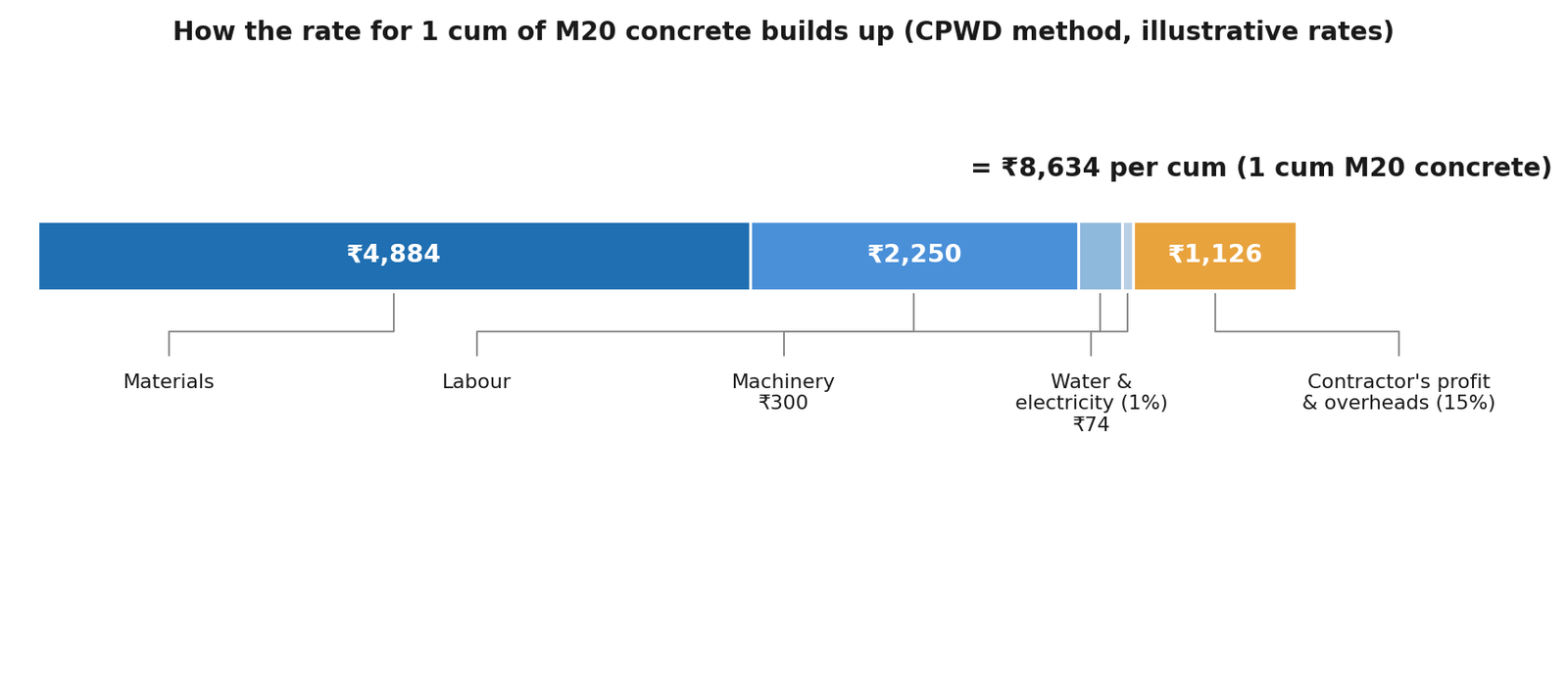
Table of contents
Exam Corner, Part 1: written for GATE (CE), SSC JE, ESE and state AE/JE aspirants, and equally useful for engineers and contractors on site.
1. What Is Rate Analysis?
Rate analysis (also called analysis of rates) is the process of working out the cost per unit of an item of work, say one cubic metre of M20 concrete or one cubic metre of brickwork. You break the item into its ingredients: materials, labour and machinery, then add water and electricity charges and finally the contractor’s profit and overheads. The result is the rate that appears in an estimate or a bill of quantities.
Every item in a CPWD Delhi Schedule of Rates (DSR) has exactly this exercise behind it. Once you can build up a rate yourself, you can check any rate that is put in front of you, whether in an exam question or in a contractor’s bill.
2. Why Rate Analysis Matters
- For exams: GATE Civil Engineering added Section 8, Construction Materials and Management, and rate analysis questions appear regularly there. SSC JE, ESE and state AE/JE papers ask it almost every year, both as numericals and as one-mark MCQs.
- For estimates: the cost of a work is quantities multiplied by analysed rates. A wrong rate means a wrong estimate.
- For contracts: when extra or deviated items come up on a work, their rates are fixed through rate analysis supported by market-rate vouchers. If you administer contracts, you will use this skill throughout your career.
3. The CPWD Method: Building Up an Item Rate
CPWD builds up the rate of an item in five steps. The percentages below are the standard allowances used throughout the CPWD Delhi Analysis of Rates (DAR) 2023, Vol I:
- Materials: work out the quantity of each material needed for one unit of finished work (including wastage), and multiply by the market rate at the site, including carriage to site.
- Labour: from standard labour coefficients (task work or out-turn norms), work out the number of masons, beldars, bhistis and other workers needed per unit, and multiply by daily wages.
- Machinery (plant and equipment): add hire charges of mixers, vibrators, pumps, etc. used for the item, including operator and fuel where applicable.
- Water and electricity charges: add about 1% of the total of the above three heads towards water for mixing and curing and electricity for equipment.
- Contractor’s profit and overheads (CPOH): add 15% of the total so far, that is on the cost of materials, labour and machinery plus the 1% water and electricity charges. This covers site and office overheads, supervision, tools and plant establishment, and the contractor’s profit.
Key formula: Rate of an item = (Materials + Labour + Machinery) + 1% for water and electricity + 15% for contractor’s profit and overheads (CPOH)
Remember the two figures every examiner loves: 1% for water and electricity, and 15% for contractor’s profit and overheads.
4. Worked Example: Rate for 1 cum of M20 Concrete, Nominal Mix 1:1.5:3 (Illustrative, Before GST)
M20 is the minimum grade permitted for RCC work as per IS 456. For a nominal mix of 1:1.5:3 (cement : sand : coarse aggregate by volume), the quantities for 1 cum of finished concrete are worked out from the dry volume of materials.
Step A, quantities: concrete shrinks when mixed with water, so the dry volume of materials needed is about 1.54 times the wet volume. For 1 cum of finished concrete:
- Dry volume = 1 x 1.54 = 1.54 cum; sum of mix parts = 1 + 1.5 + 3 = 5.5
- Cement = 1.54 / 5.5 = 0.28 cum; at 1,440 kg per cum this is about 403 kg, or 8.1 bags of 50 kg
- Sand (fine aggregate) = 0.28 x 1.5 = 0.42 cum
- Coarse aggregate (20 mm) = 0.28 x 3 = 0.84 cum
Step B, cost of materials (rates are illustrative, roughly current Delhi-level rates):
| Material | Quantity | Unit | Rate (Rs) | Amount (Rs) |
|---|---|---|---|---|
| Cement (OPC, 50 kg bags) | 8.1 | bag | 380 | 3,078 |
| Sand (fine aggregate) | 0.42 | cum | 1,500 | 630 |
| Coarse aggregate (20 mm) | 0.84 | cum | 1,400 | 1,176 |
| Total cost of materials | 4,884 |
Step C, the complete rate build-up:
| Sl. | Component | Basis | Amount (Rs) |
|---|---|---|---|
| A | Materials | From the table above | 4,884 |
| B | Labour | Mason 0.5 no @ Rs 900/day; beldar 2 nos @ Rs 800/day; bhisti 0.25 no @ Rs 800/day | 2,250 |
| C | Machinery | Concrete mixer with operator Rs 200; needle vibrator Rs 100 | 300 |
| D | Sub-total | A + B + C | 7,434 |
| E | Water and electricity charges | 1% of D | 74 |
| F | Total cost | D + E | 7,508 |
| G | Contractor’s profit and overheads | 15% of F (before GST) | 1,126 |
| H | Rate for 1 cum of M20 concrete | F + G | 8,634 (say Rs 8,635) |
The figure below shows how each component stacks up to the final rate.
A note on rates: the rates in this example are illustrative, and this is a before-GST build-up meant for learning the method, not a DAR or DSR item rate. In the CPWD DAR 2023, works-contract GST (18%) and labour cess are added in the analysis of every item over and above the 1% and 15% shown here, so printed DAR/DSR rates are higher than a bare before-GST build-up. In an exam, follow the rates and the sequence given in the question. In an estimate, use the current DSR or market rates for your station. The method and the coefficients stay the same; only the rates change.
5. How Exams Ask Rate Analysis
GATE (CE, Section 8): expect a 1 or 2 mark numerical. You are given material rates, labour coefficients and wages, and asked for the rate per unit of an item. Work through the five steps above in order; most marks are lost by forgetting either the 1% or the 15%, or by using wet volume instead of dry volume for material quantities.
SSC JE, ESE and state AE/JE: MCQs from rate analysis repeat year after year. The favourites:
- Analysis of rates means the determination of the rate per unit of an item of work.
- CPWD adds 15% for contractor’s profit and overheads (CPOH).
- About 1% (up to 1.5%) is added for water and electricity charges.
- Dry volume of cement concrete is about 1.54 times the wet volume; for cement mortar, about 1.30 times.
- Prime cost is the actual cost of materials and labour at site, excluding overheads and profit.
- Purposes of rate analysis: fixing rates for extra or deviated items, checking the reasonableness of tendered rates, and preparing revised estimates.
- Task work (out-turn): a mason with helpers lays about 1.25 cum of brickwork in foundation and plinth per day. Similar standard out-turns exist for concreting, plastering and earthwork.
- Factors affecting rate analysis: material prices and lead (carriage distance), labour wages and output, plant hire charges, site location, quantity of work, and the specification of the item.
6. Practical Notes from Contract Administration
A few things you only learn once you start pricing real works:
- Schedule of rates and estimates: government estimates are priced at DSR (or state schedule) rates. Every schedule item has an analysis of the kind above behind it, which is why DSR rates for the same item are uniform across works in a circle.
- Tendered rates: in percentage-rate tenders, contractors quote a percentage above or below the schedule. Knowing the analysis behind the schedule rate tells you whether a very low quoted percentage is workable or a recipe for poor quality and disputes later.
- Extra and deviated items (variations): when an item is not in the agreement schedule, its rate is settled by rate analysis, supported by market-rate vouchers for materials and observed labour input. As the engineer, you check the quantities, the labour coefficients and the reasonableness of the rates before recommending the analysed rate.
- Carriage matters: the lead from the source of sand, aggregate or cement to the site can change a rate significantly, especially in hill districts. Two sites a few kilometres apart can legitimately carry different analysed rates for the same item.
- Site use: on site, the analysis tells you what a rate actually covers: the mix, the labour gang, curing water and the machinery. When a contractor claims a rate is unworkable, the analysis is where you look first.
7. Key Takeaways
Rate analysis = materials + labour + machinery, plus 1% for water and electricity, plus 15% for contractor’s profit and overheads. For 1 cum of concrete, materials are worked out from a dry volume of about 1.54 times the wet volume. The same method prices estimates, checks tendered rates and settles extra items on a work.
This is the first article in the Exam Corner series for GATE, SSC JE, ESE and state AE/JE aspirants. Next in the series: types of estimates (preliminary, plinth area, cube rate, detailed and revised estimates) and how examiners ask them.
Rajesh Pant is a Civil Engineer and Infrastructure Management professional with approximately 25 years of experience in the planning, implementation, coordination, management and execution of large-scale government infrastructure projects. His professional experience encompasses project management, procurement, contract administration, construction management and quality control of infrastructure projects. He also possesses nearly eight years of experience in Externally Aided Projects (EAPs), particularly in project implementation, procurement and contract management of World Bank-funded projects. His professional exposure includes working with projects financed by multilateral development organisations, providing valuable insights into international procurement practices, project implementation frameworks and contract management requirements. He holds a Master of Technology (M.Tech.) in Civil Engineering and a Master of Business Administration (MBA) in Infrastructure Management, combining technical engineering expertise with management and administrative capabilities. With extensive experience in public infrastructure development and government project management, Rajesh brings a practical, multidisciplinary perspective to the fields of contract management, procurement, project management and construction management.