Employer’s Claims under FIDIC: Sub-Clause 2.5 (1999) and Sub-Clause 20.2 (2017)
Table of contents
- Introduction
- 1. What are Employer’s Claims under FIDIC?
- 2. Employer’s Claims under FIDIC 1999 – Sub-Clause 2.5
- 3. What if the Employer is Late? The NH International Case
- 4. Employer’s Claims under FIDIC 2017 – Sub-Clause 20.2
- 5. Practical Example – Employer’s Claim for Delay Damages
- 6. Difference between Employer’s Claims under FIDIC 1999 and 2017
- 7. Important Precautions for Employers and Engineers
- Conclusion
Introduction
Construction contracts do not provide rights and remedies only to Contractors. Employers also have contractual rights to recover additional costs, claim damages, seek an extension of the Defects Notification Period (DNP), or obtain a reduction in the Contract Price where the Contractor fails to fulfil its contractual obligations.
FIDIC provides a formal mechanism for exercising these rights through Employer’s Claims. Under the FIDIC 1999 Red Book, Employer’s Claims are governed by Sub-Clause 2.5, whereas under the FIDIC 2017 Red Book, they are covered by Sub-Clause 20.2 – Claims for Payment and/or EOT. The 2017 edition introduced a significant change by bringing Employer’s and Contractor’s claims under a common procedure.
1. What are Employer’s Claims under FIDIC?
An Employer’s Claim is a formal claim made by the Employer against the Contractor for payment, reduction in the Contract Price, or extension of the Defects Notification Period, where the Employer believes that it has a contractual entitlement.
Common examples include:
- Delay damages due to late completion of the Works.
- Recovery of additional costs incurred because of the Contractor’s failure to fulfil contractual obligations.
- Recovery of costs incurred in remedying defective work.
- Recovery of additional costs due to the Contractor’s failure to comply with contractual instructions.
- Extension of the Defects Notification Period where defects prevent the Works or a Section from being used for their intended purpose.
- Reduction in the Contract Price where the Employer accepts defective work in accordance with the Contract.
The Employer must establish the contractual basis of the claim and substantiate the amount or relief sought.
2. Employer’s Claims under FIDIC 1999 – Sub-Clause 2.5
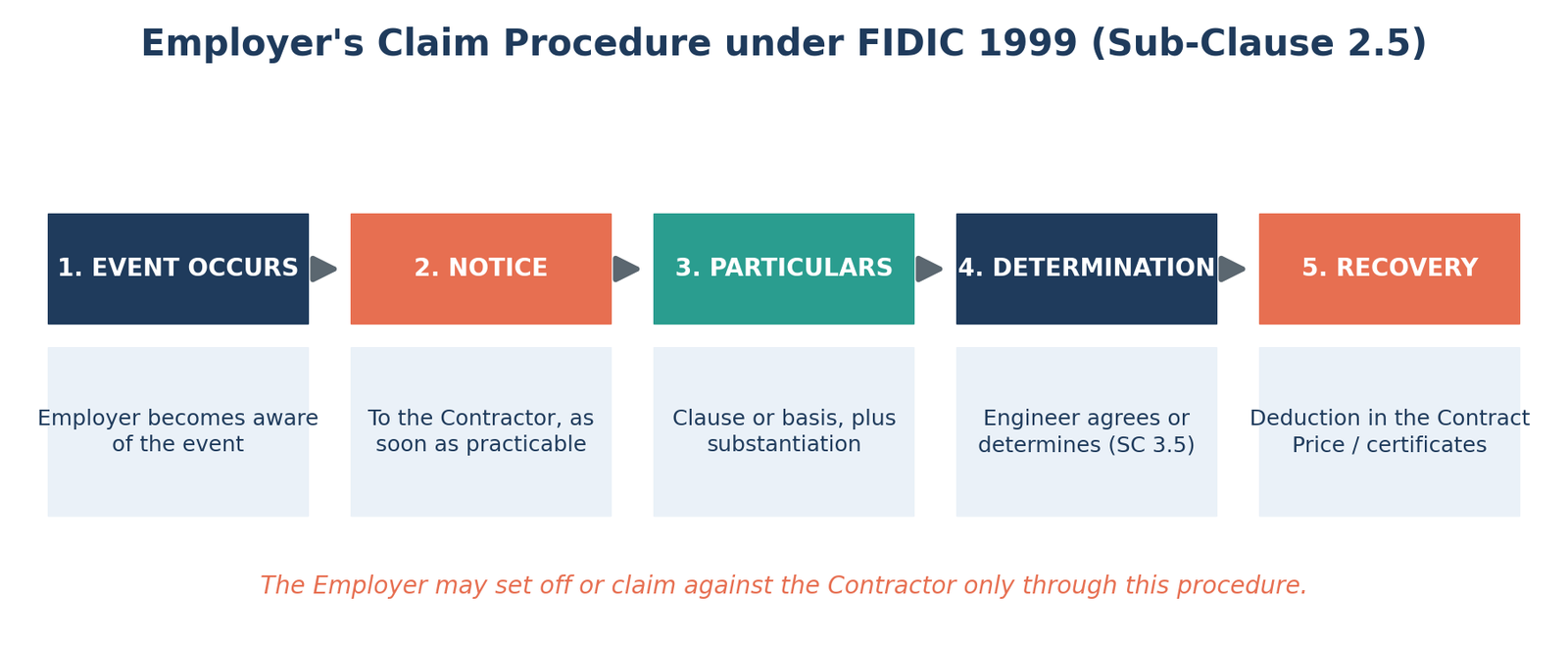
Sub-Clause 2.5 of the 1999 Red Book deals specifically with Employer’s Claims. If the Employer considers itself entitled to payment under any provision of the Contract, or otherwise in connection with the Contract, and/or an extension of the Defects Notification Period, the Employer or the Engineer must give notice and particulars to the Contractor.
A. Notice of Claim
The Employer or Engineer must give notice as soon as practicable after the Employer becomes aware of the event or circumstance giving rise to the claim. Unlike the Contractor’s Claims procedure under Sub-Clause 20.1, Sub-Clause 2.5 does not prescribe a general fixed 28-day notice period for Employer’s Claims.
However, a notice seeking an extension of the Defects Notification Period must be issued before the expiry of that period.
B. Particulars of the Claim
The notice must specify:
- The relevant contractual clause or other basis of the claim.
- The event or circumstance giving rise to the claim.
- The amount of payment sought, with supporting calculations and evidence.
- The extension of the Defects Notification Period sought, where applicable.
The Employer must provide sufficient particulars to enable the Contractor and Engineer to understand and examine the claim.
C. Engineer’s Determination
After receiving the notice and particulars, the Engineer proceeds under Sub-Clause 3.5 – Determinations. The Engineer must consult both parties to endeavour to reach agreement.
If agreement is not achieved, the Engineer makes a fair determination in accordance with the Contract, taking due regard of all relevant circumstances. The Engineer communicates the agreement or determination to both parties with supporting particulars.
D. Recovery and Deduction
Any amount determined as payable by the Contractor to the Employer may be included as a deduction in the Contract Price and Payment Certificates.
Importantly, the Employer is entitled to set off against or make deductions from amounts certified in a Payment Certificate, or otherwise claim against the Contractor, only in accordance with Sub-Clause 2.5.
Certain specified payments, including payments under Sub-Clauses 4.19 and 4.20, are exempt from the notice requirement under the standard wording.
3. What if the Employer is Late? The NH International Case
The 1999 wording contains no express time bar for a late Employer’s notice, and for many years it was assumed that late notice did not cost the Employer its claim.
In NH International (Caribbean) Ltd v National Insurance Property Development Company Ltd [2015] UKPC 37, the Privy Council decided otherwise. The Employer had never given Sub-Clause 2.5 notices and tried to raise its claims later, as counterclaims in arbitration after the contract was terminated.
The Privy Council held that an Employer’s claim, whether raised as an original claim, a set-off or a counterclaim, is not allowed unless it has been notified in accordance with Sub-Clause 2.5. Where the Employer has failed to give the required notice, “the back door of set-off or cross-claims is as firmly shut to it as the front door of an originating claim.”
The judgment did not define “as soon as practicable”, which remains a question of fact for each project, and it observed that in practice this requirement could be stricter than the Contractor’s 28 days.
Practical lesson for Employers: notify every claim promptly and in a particularised form, even when no Payment Certificate is immediately due. For Contractors: a deduction made without a Sub-Clause 2.5 notice and determination can be challenged.
4. Employer’s Claims under FIDIC 2017 – Sub-Clause 20.2
The 2017 edition introduced a more structured and reciprocal claims procedure. Both the Employer and Contractor follow the same general procedure for claims involving payment, reduction in the Contract Price, EOT or extension of the DNP. The relevant provisions are:
| Sub-clause | Subject |
|---|---|
| 20.2.1 | Notice of Claim |
| 20.2.2 | Engineer’s Initial Response |
| 20.2.3 | Contemporary Records |
| 20.2.4 | Fully Detailed Claim |
| 20.2.5 | Agreement or Determination of the Claim |
| 20.2.6 | Claims of Continuing Effect |
| 20.2.7 | General Requirements |
A. Notice of Claim – 28 Days
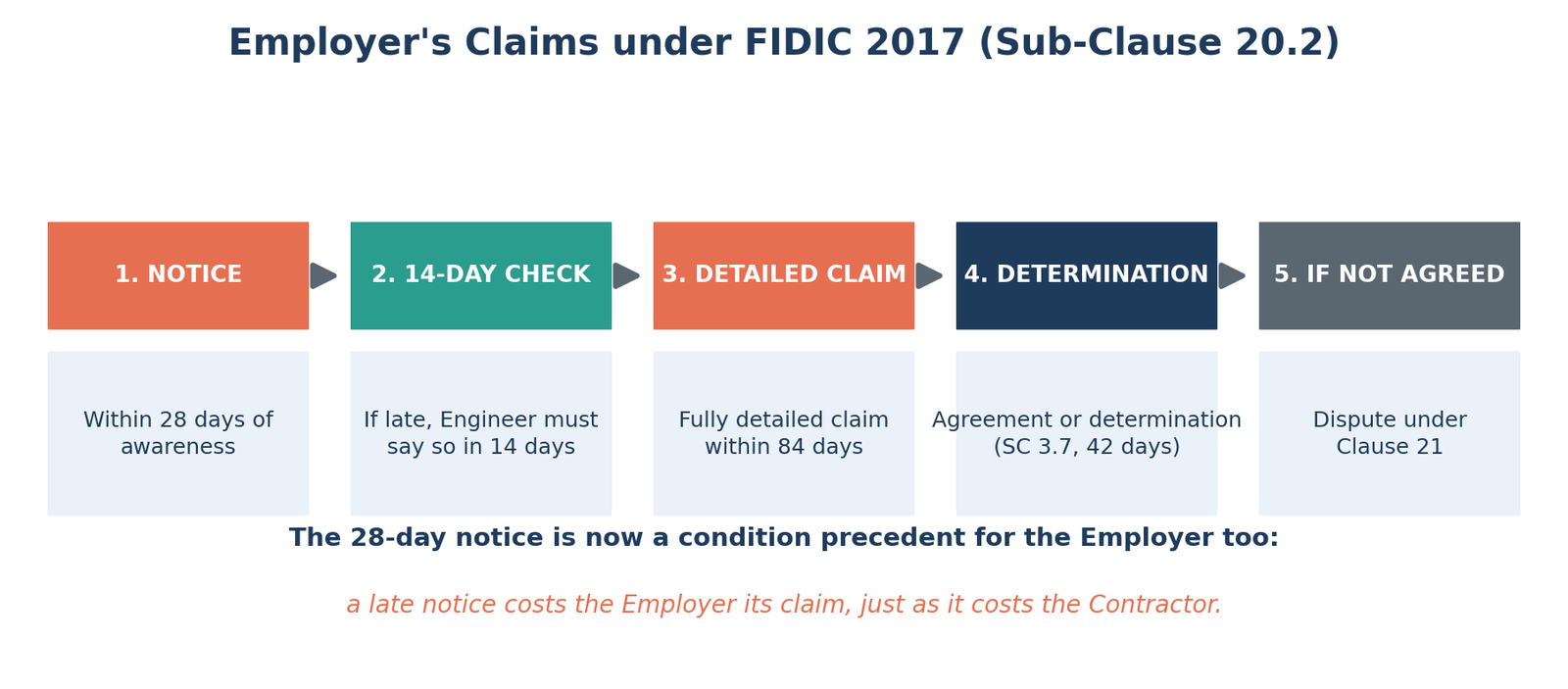
The claiming party must give a Notice to the Engineer describing the event or circumstance giving rise to the claim. The notice must be submitted as soon as practicable and no later than 28 days after the claiming party became aware, or should have become aware, of the event or circumstance.
For Employer’s Claims, failure to submit the notice within this period can result in the Employer losing its entitlement to additional payment, reduction in the Contract Price or extension of the DNP in respect of the event.
B. Engineer’s Initial Response – 14 Days
Under Sub-Clause 20.2.2, if the Engineer considers that the Notice of Claim was submitted after the 28-day period, the Engineer must notify the claiming party within 14 days of receiving the notice, giving reasons. If the Engineer does not issue such a notice within 14 days, the Notice of Claim is deemed valid under the contractual procedure.
The validity of the notice may still be examined through the subsequent claim determination process in the circumstances specified by the Contract.
C. Contemporary Records
Under Sub-Clause 20.2.3, the claiming party must maintain contemporary records to substantiate the claim. These may include:
- Site inspection reports.
- Photographs and videos.
- Daily progress reports.
- Measurement records.
- Quality inspection and testing reports.
- Correspondence and Engineer’s instructions.
- Cost statements and invoices.
- Records of defects and remedial works.
Contemporaneous records are important because they provide evidence of the actual circumstances and financial impact of the event.
D. Fully Detailed Claim – 84 Days
Under Sub-Clause 20.2.4, the claiming party must generally submit a fully detailed claim within 84 days after becoming aware, or when it should have become aware, of the event or circumstance. The submission should contain:
- A detailed description of the event or circumstance.
- The contractual and/or other legal basis of the claim.
- All contemporary records relied upon.
- Detailed supporting particulars of the amount claimed or reduction in the Contract Price, and/or extension of the DNP.
Another period may be agreed with the Engineer in accordance with the Sub-Clause.
If the statement of the contractual and/or other legal basis of the claim is not submitted within this period, the Notice of Claim is deemed to have lapsed.
E. Agreement or Determination – Sub-Clause 20.2.5
After receiving the fully detailed claim, the Engineer proceeds under Sub-Clause 3.7 – Agreement or Determination. The Engineer examines the contractual entitlement and supporting evidence, consults the parties and seeks to reach agreement. If agreement is not achieved, the Engineer makes a determination in accordance with the contractual procedure. The determination may establish the amount payable by the Contractor to the Employer or the appropriate reduction in the Contract Price.
F. Claims of Continuing Effect
Where the event giving rise to the claim has a continuing effect, the claiming party must submit interim fully detailed claims at monthly intervals. A final fully detailed claim must generally be submitted within 28 days after the effects of the event end, unless another period is agreed with the Engineer.
5. Practical Example – Employer’s Claim for Delay Damages
Consider a road construction project with the following details:
| Particulars | Details |
|---|---|
| Accepted Contract Amount | Rs. 20 crore |
| Original Time for Completion | 24 months |
| Approved EOT | 30 days |
| Revised completion date | 30 June 2026 |
| Actual completion date | 20 July 2026 |
| Delay beyond revised completion | 20 days |
| Delay damages rate | 0.05% per day |
| Maximum limit of delay damages | 10% of Contract Price |
Calculation of Delay Damages
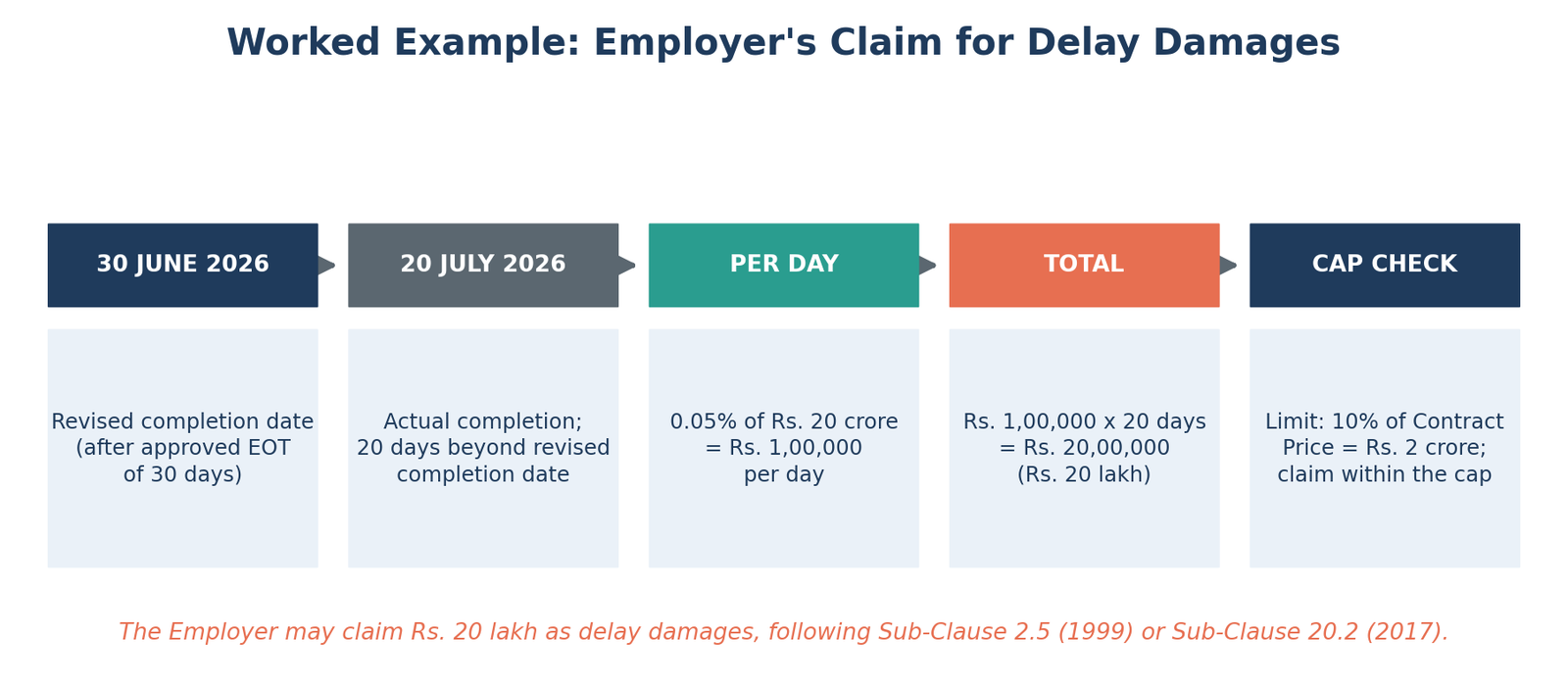
Daily delay damages: 0.05% × Rs. 20 crore = Rs. 1,00,000 per day
Total delay damages: Rs. 1,00,000 × 20 days = Rs. 20,00,000
Therefore, the Employer may claim Rs. 20 lakh as delay damages, subject to the contractual requirements, applicable cap and any other relevant provisions.
Procedure under FIDIC 1999:
- The Employer or Engineer issues notice and particulars under Sub-Clause 2.5 as soon as practicable after becoming aware of the relevant circumstances.
- The Engineer examines the claim and proceeds under Sub-Clause 3.5.
- The amount agreed or determined may be deducted from the Contract Price and Payment Certificates in accordance with Sub-Clause 2.5.
Procedure under FIDIC 2017:
- The Employer submits a Notice of Claim within 28 days under Sub-Clause 20.2.1.
- The Engineer follows the initial response procedure, where applicable.
- The Employer submits the fully detailed claim, generally within 84 days.
- The Engineer agrees or determines the claim under Sub-Clause 20.2.5 and Sub-Clause 3.7.
The example assumes that the Contractor has no further entitlement to EOT for the period in question and that the delay damages provision applies.
6. Difference between Employer’s Claims under FIDIC 1999 and 2017
| Particulars | FIDIC 1999 | FIDIC 2017 |
|---|---|---|
| Relevant provision | Sub-Clause 2.5 | Sub-Clause 20.2 |
| Claims procedure | Separate procedure for Employer’s Claims | Common procedure for Employer and Contractor |
| Notice period | As soon as practicable; no general fixed 28-day period | Within 28 days |
| Engineer’s initial response | No equivalent 14-day response mechanism | Generally 14 days for notice-validity response |
| Detailed claim | Particulars required, but no general 84-day deadline under 2.5 | Generally within 84 days |
| Contemporary records | No equivalent express general requirement in 2.5 | Expressly addressed under 20.2.3 |
| Determination | Sub-Clause 3.5 | Sub-Clause 3.7 |
| Dispute resolution | Clause 20 | Clause 21 |
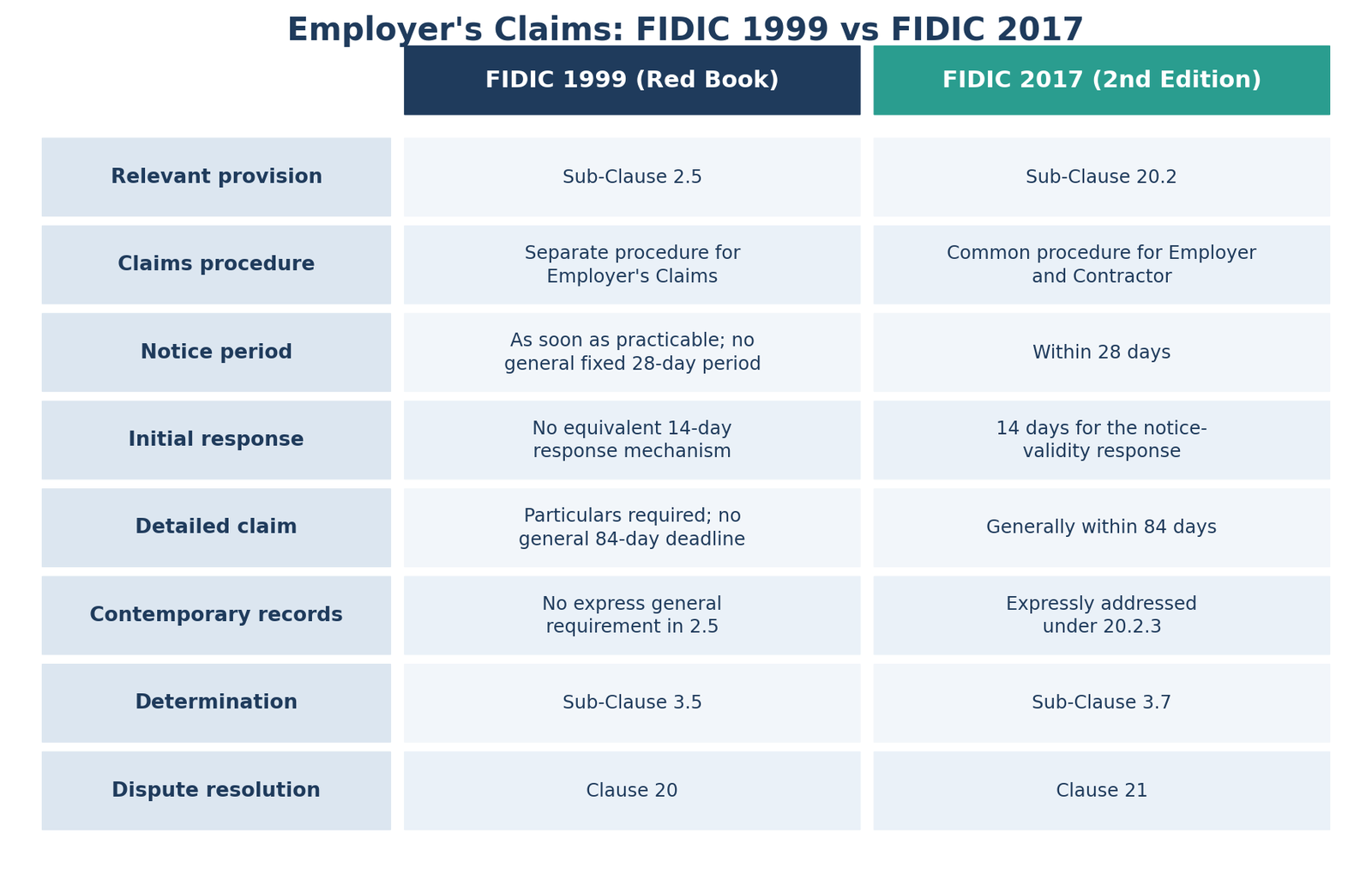
The most significant change is that FIDIC 2017 applies a common and more detailed procedure to both parties, promoting greater procedural consistency.
7. Important Precautions for Employers and Engineers
- Identify the contractual basis of every Employer’s Claim.
- Issue notices within the applicable contractual time limits.
- Maintain records supporting the amount claimed.
- Ensure that delay damages are calculated after considering approved EOT and the relevant completion dates.
- Do not make unilateral deductions without complying with the applicable contractual procedure.
- Distinguish between recovery of actual additional costs and contractual delay damages.
- Check the Particular Conditions for amendments to the General Conditions.
- Ensure that the Engineer’s agreement or determination is supported by reasons and relevant evidence.
Additional precautions for Contractors:
- Check every deduction against the procedure: was there a proper notice, particulars and a determination?
- On a 2017 contract, watch the Engineer’s 14-day response. If the Engineer does not challenge a late notice in time, it is deemed valid.
- Respond to Employer’s claim notices promptly and in writing. Silence weakens your position.
Conclusion
Employer’s Claims are an important part of FIDIC contract administration. They protect the Employer’s contractual rights to recover amounts due, claim delay damages, recover remedial costs and seek an extension of the Defects Notification Period.
Under FIDIC 1999, Sub-Clause 2.5 provides a separate procedure for Employer’s Claims. The 2017 edition brings Employer’s and Contractor’s Claims under a common procedure through Sub-Clause 20.2, introducing clearer notice requirements, time limits, record-keeping obligations and claim assessment procedures.
Employers, Engineers and Contractors should understand these provisions to ensure that claims are properly notified, substantiated and determined, thereby reducing the likelihood of contractual disputes.
Rajesh Pant is a Civil Engineer and Infrastructure Management professional with approximately 25 years of experience in the planning, implementation, coordination, management and execution of large-scale government infrastructure projects. His professional experience encompasses project management, procurement, contract administration, construction management and quality control of infrastructure projects. He also possesses nearly eight years of experience in Externally Aided Projects (EAPs), particularly in project implementation, procurement and contract management of World Bank-funded projects. His professional exposure includes working with projects financed by multilateral development organisations, providing valuable insights into international procurement practices, project implementation frameworks and contract management requirements. He holds a Master of Technology (M.Tech.) in Civil Engineering and a Master of Business Administration (MBA) in Infrastructure Management, combining technical engineering expertise with management and administrative capabilities. With extensive experience in public infrastructure development and government project management, Rajesh brings a practical, multidisciplinary perspective to the fields of contract management, procurement, project management and construction management.