FIDIC Sub-Clause 20.1 – Contractor’s Claims: Procedure, Time Limits and Practical Example
Table of contents
- Introduction
- 1. What is a Contractor’s Claim under Sub-Clause 20.1?
- 2. Important Time Limits under Sub-Clause 20.1
- 3. Step-by-Step Procedure for Submitting a Claim
- 4. Practical Example – Delay in Handing Over the Site
- 5. Difference Between EOT Claim and Additional Payment Claim
- 6. Important Precautions for Contractors and Engineers
- 7. How Does the 2017 Edition Differ?
- Conclusion
FIDIC 1999 Red Book, with the 2017 edition compared
Introduction
Construction projects frequently encounter delays, unforeseen site conditions, changes in scope, delayed approvals and other circumstances that may affect the Contractor’s time and cost.
FIDIC provides a contractual mechanism for addressing such situations through claims. Under the FIDIC 1999 Red Book, Sub-Clause 20.1 – Contractor’s Claims establishes the procedure for a Contractor to claim an Extension of Time (EOT) and/or additional payment.
Compliance with this procedure is important because failure to submit the required notice within the prescribed time may affect the Contractor’s contractual entitlement.
1. What is a Contractor’s Claim under Sub-Clause 20.1?
A Contractor’s claim is a formal request for contractual relief arising from an event or circumstance for which the Contractor believes it is entitled to additional time or payment under the Contract.
Common examples include:
- Delay in handing over the construction site.
- Late issuance of drawings or instructions by the Engineer.
- Delayed approvals by the Employer.
- Unforeseen physical conditions at the site.
- Suspension of work instructed by the Engineer.
- Delays caused by variations or changes in the Employer’s requirements.
- Exceptional events affecting project execution.
The Contractor must establish the contractual basis of the claim and demonstrate its impact on time and/or cost.
2. Important Time Limits under Sub-Clause 20.1
The 1999 Red Book prescribes specific time limits for submitting claims.
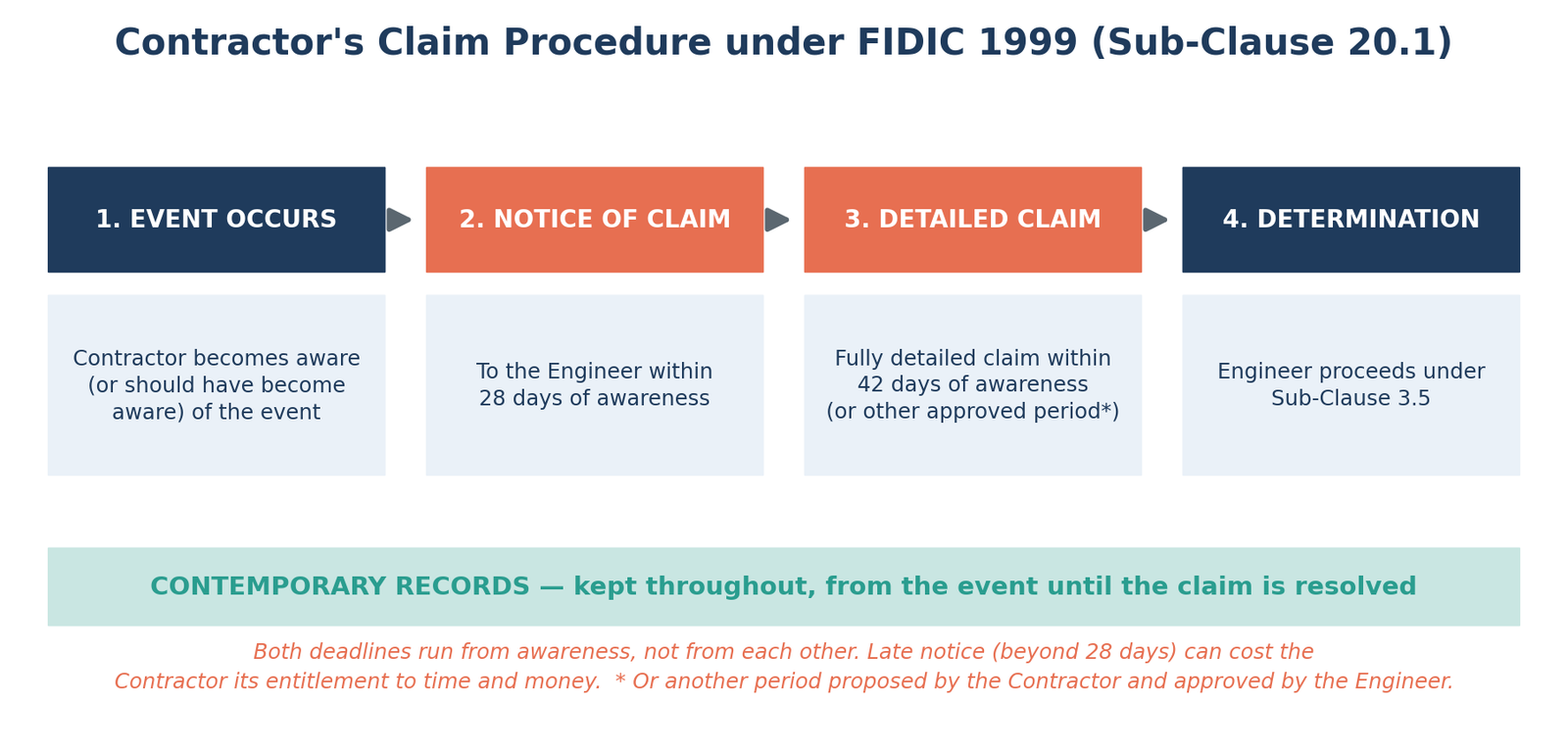
A. Notice of Claim – 28 Days
The Contractor must give notice to the Engineer describing the event or circumstance giving rise to the claim.
The notice must be submitted as soon as practicable and not later than 28 days after the Contractor became aware, or should have become aware, of the event or circumstance.
This is a critical contractual requirement. Under the standard wording, failure to give notice within 28 days can result in the Contractor losing its entitlement to an extension of time and additional payment in respect of that claim.
B. Fully Detailed Claim – 42 Days
Within 42 days after the Contractor became aware, or should have become aware, of the event or circumstance, or within another period proposed by the Contractor and approved by the Engineer, the Contractor must submit a fully detailed claim.
The claim should include:
- A detailed description of the event.
- Relevant contractual provisions.
- Chronology of events.
- Reasons for the Contractor’s entitlement.
- Details of delay and its impact on project completion.
- Cost calculations and supporting documents.
- Relevant records and correspondence.
The Engineer may require additional particulars where necessary.
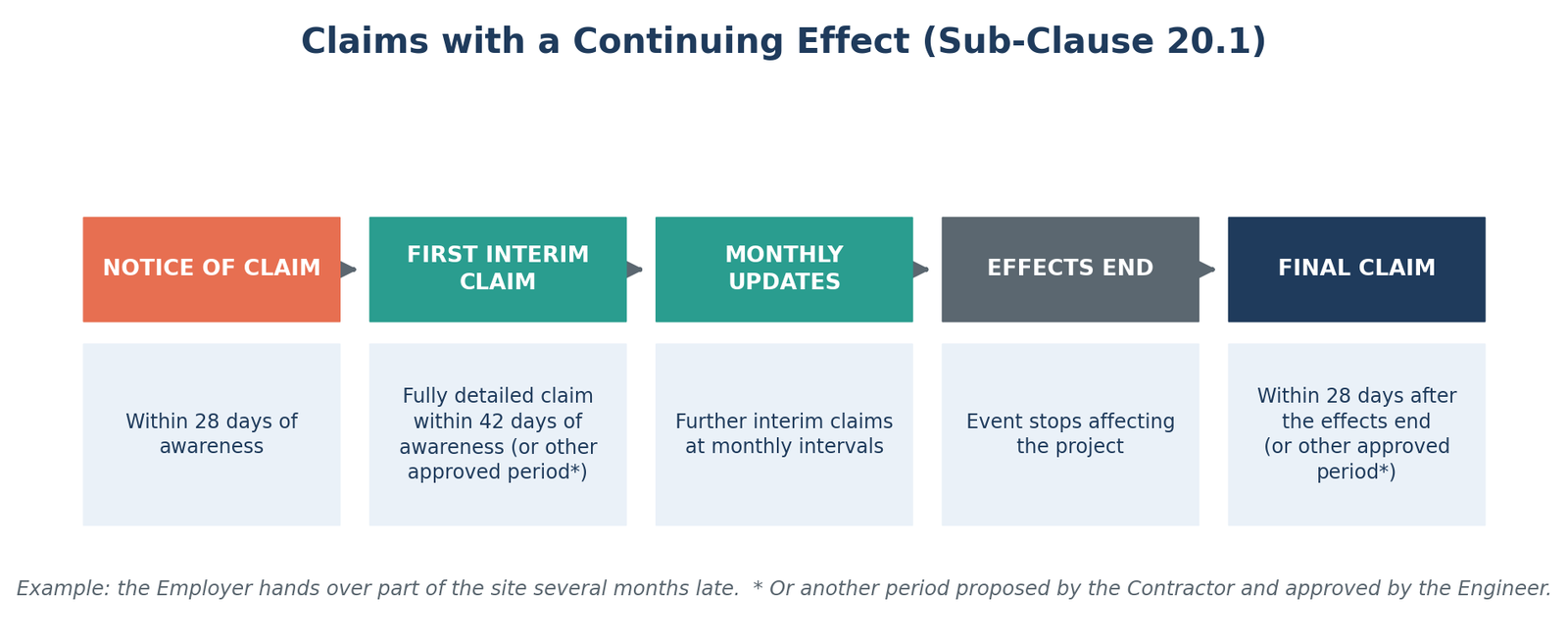
C. Continuing Events
Sometimes the event giving rise to a claim continues over an extended period. For example, the Employer may fail to hand over a particular portion of the site for several months.
In such cases, the Contractor must:
- Submit interim claims at monthly intervals.
- Provide updated particulars of the continuing effects.
- Submit a final claim within 28 days after the effects of the event or circumstance end, or within another period proposed by the Contractor and approved by the Engineer.
These requirements ensure that the claim is updated as the project progresses.
3. Step-by-Step Procedure for Submitting a Claim
A Contractor should follow a systematic process to prepare a claim.
Step 1: Identify the event
Identify the event or circumstance that has affected the project and determine whether the Contract provides an entitlement to EOT or additional payment.
Step 2: Issue Notice of Claim
Submit written notice to the Engineer within 28 days of becoming aware of the event. Clearly identify the event and state that the Contractor intends to claim contractual relief.
Step 3: Maintain records
Maintain contemporaneous records, including:
- Site diaries and daily progress reports.
- Photographs and inspection reports.
- Correspondence and instructions.
- Approved and updated project programmes.
- Labour and equipment deployment records.
- Material consumption and expenditure records.
Step 4: Assess the impact
Determine how the event affected the critical path and completion date. For financial claims, calculate the additional costs attributable to the event and establish the contractual basis for recovery.
Step 5: Submit the fully detailed claim
Submit the claim within 42 days, containing the factual background, contractual entitlement, delay analysis, cost calculations and supporting evidence.
Step 6: Cooperate with the Engineer
Provide additional information and records if requested. The Engineer may monitor the record-keeping process and inspect the relevant records.
Step 7: Assessment and determination
The Engineer examines the claim and makes a determination under Sub-Clause 3.5 of the 1999 Red Book, following consultation with the parties and the contractual procedure.
4. Practical Example – Delay in Handing Over the Site
Suppose a road construction contract has a completion period of 24 months.
The Employer is required to hand over the entire construction site to the Contractor. However, due to land acquisition issues, a 5 km stretch of the road is not handed over on the scheduled date.
The delayed handover affects the construction programme and prevents the Contractor from completing certain critical activities.
The Contractor should take the following actions:
| Particulars | Action |
|---|---|
| Date of awareness | 1 January |
| Notice of Claim | Submit by 29 January, subject to the contractual calculation of time |
| Detailed Claim | Submit within 42 days of awareness |
| Supporting evidence | Site handover records, correspondence and approved programme |
| Delay assessment | Demonstrate the effect on the critical path |
| Relief claimed | EOT and eligible additional payment |
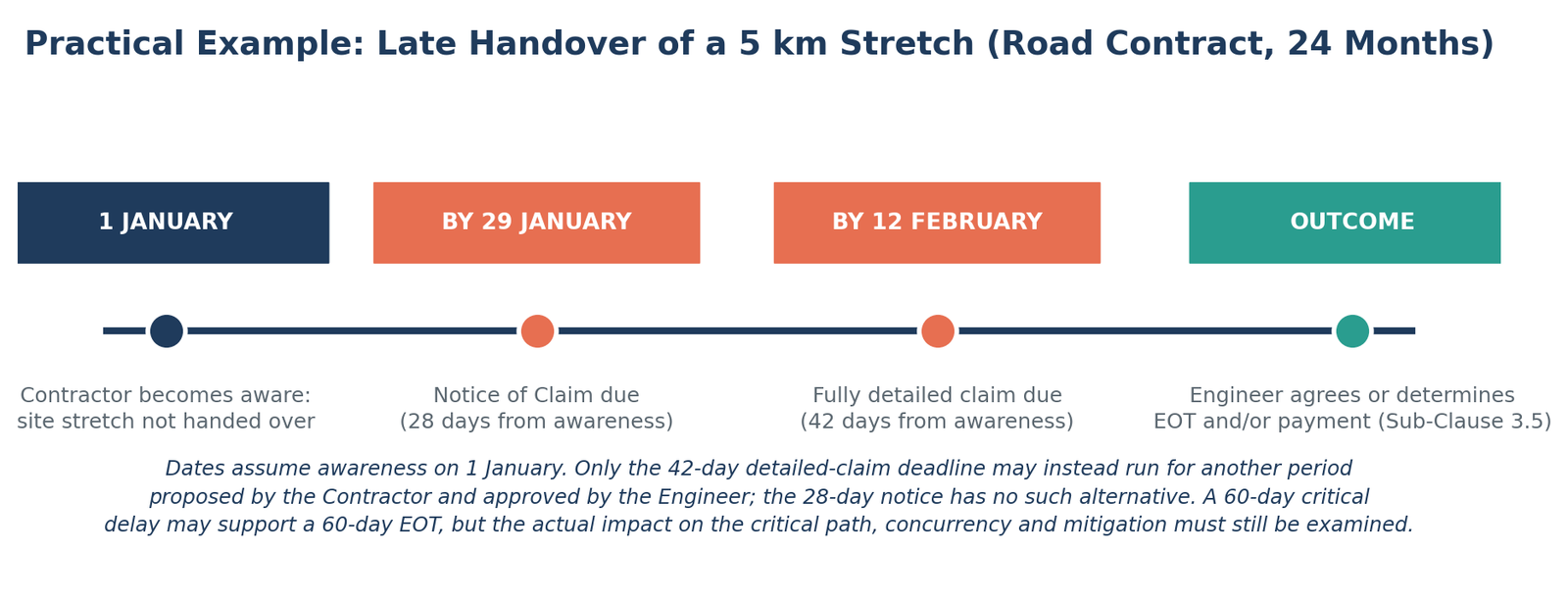
Assume the delay in site handover ultimately causes 60 days of critical delay to project completion. The Contractor may claim an EOT of 60 days, provided it establishes contractual entitlement and satisfies the relevant requirements.
However, the Contractor cannot automatically claim 60 days merely because the site was handed over late. The actual impact on the critical path, any concurrent delay, mitigation and other contractual requirements must be examined.
5. Difference Between EOT Claim and Additional Payment Claim
A claim under Sub-Clause 20.1 may involve time, money or both.
| Basis | EOT Claim | Additional Payment Claim |
|---|---|---|
| Purpose | Extension of completion time | Recovery of additional costs |
| Main impact | Delay to completion | Financial impact |
| Supporting documents | Programme, delay analysis and site records | Cost records, invoices and resource details |
| Example | Delayed site handover affecting critical activities | Additional site overheads due to compensable delay |
An important point is that granting an EOT does not automatically entitle the Contractor to prolongation costs. The Contractor must establish a separate contractual basis for additional payment.
6. Important Precautions for Contractors and Engineers
- Do not wait until the end of the project to submit a claim notice.
- Maintain proper contemporaneous records.
- Identify the relevant contractual provisions.
- Establish the cause-and-effect relationship between the event and its impact.
- Distinguish between critical and non-critical delays.
- Avoid claiming costs without supporting evidence.
- Check the Particular Conditions for amendments to Sub-Clause 20.1.
- Maintain proper correspondence and records of instructions and approvals.
7. How Does the 2017 Edition Differ?
The FIDIC 2017 Red Book substantially revises the claims procedure.
The corresponding provisions are:
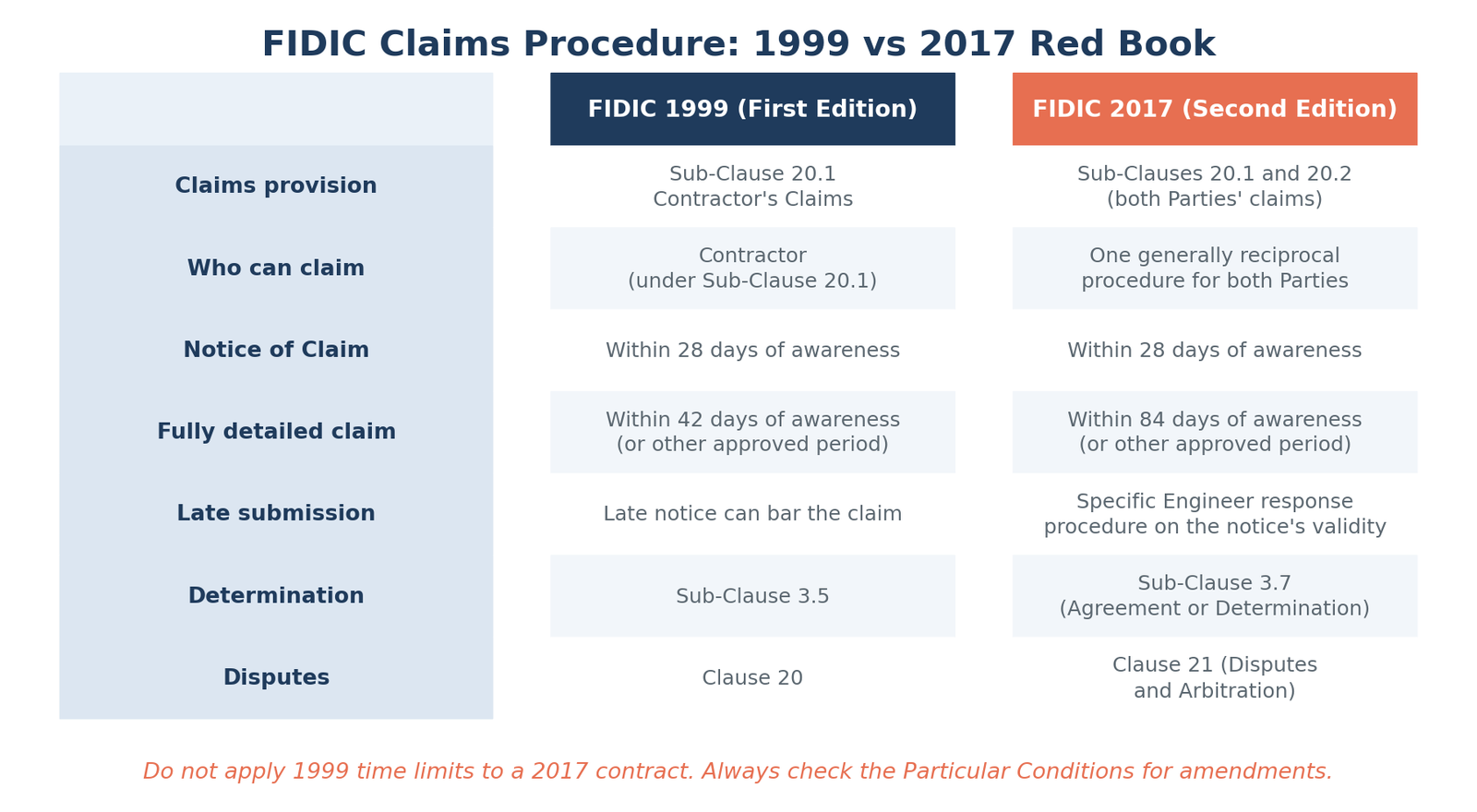
- Sub-Clause 20.1: Claims (covering both the Employer and the Contractor).
- Sub-Clause 20.2: Claims for Payment and/or EOT.
- Sub-Clause 3.7: Agreement or Determination by the Engineer.
- Clause 21: Disputes and Arbitration.
The 2017 edition introduces a more detailed and generally reciprocal claims procedure for the Employer and Contractor. The initial notice period remains 28 days, while the fully detailed claim is generally due within 84 days. It also introduces a specific response procedure for the Engineer regarding the validity of the notice.
Therefore, professionals should not apply the 1999 time limits and procedures to a 2017 contract.
Conclusion
FIDIC Sub-Clause 20.1 is an important provision for protecting the Contractor’s contractual rights when project events affect time or cost. Timely notice, proper documentation, substantiation of entitlement and a clear assessment of delay and financial impact are essential for a successful claim.
Contractors, Engineers and Employers should understand the claims procedure before project execution rather than attempting to reconstruct the events after disputes have arisen.
Rajesh Pant is a Civil Engineer and Infrastructure Management professional with approximately 25 years of experience in the planning, implementation, coordination, management and execution of large-scale government infrastructure projects. His professional experience encompasses project management, procurement, contract administration, construction management and quality control of infrastructure projects. He also possesses nearly eight years of experience in Externally Aided Projects (EAPs), particularly in project implementation, procurement and contract management of World Bank-funded projects. His professional exposure includes working with projects financed by multilateral development organisations, providing valuable insights into international procurement practices, project implementation frameworks and contract management requirements. He holds a Master of Technology (M.Tech.) in Civil Engineering and a Master of Business Administration (MBA) in Infrastructure Management, combining technical engineering expertise with management and administrative capabilities. With extensive experience in public infrastructure development and government project management, Rajesh brings a practical, multidisciplinary perspective to the fields of contract management, procurement, project management and construction management.