Variation Order vs Change Order: FIDIC Clause 13 Explained (With Example)
Table of contents
- 1. What Is a Variation Order?
- 2. What Is a Change Order?
- 3. Variation Order vs Change Order: Key Differences
- 4. What Changes Can Be Made Under FIDIC Clause 13?
- 5. Who Can Instruct a Variation, and How?
- 6. How Are Variations Valued?
- 7. Worked Example: Instructed Variation on a Road Project
- 8. Common Mistakes and Practical Precautions
- 9. Variations in Indian Public Works Contracts
- Conclusion
- Read also
- References and Further Reading
Almost every construction project faces changes after the contract is signed. Drawings are revised, quantities differ from the estimates, site conditions are found different from what was assumed, or the employer simply wants something extra.
The contract must therefore provide a clear mechanism for instructing, valuing and paying for such changes. In international contracts this mechanism is commonly called a Variation, while in US-style contract administration the corresponding document is usually called a Change Order.
This article explains what each term means, how they differ, how FIDIC Clause 13 deals with variations, and how an instructed variation is valued, with a worked example.
1. What Is a Variation Order?
A variation is any change to the scope, quantity, quality, levels, sequence or timing of the works described in the contract. A variation order is the formal written instruction that authorises that change.
Under FIDIC contracts, a Variation means a change to the Works which is instructed or approved as a variation under Clause 13 [Variations and Adjustments]. The instruction is issued by the Engineer on behalf of the employer, and the contractor is generally bound to carry it out, with the price and time effects settled under the contract.
2. What Is a Change Order?
A change order is the term commonly used in US-style contract administration for the written document that modifies the original contract scope, price or time. Under AIA Document A201-2017, a widely used US general conditions form, a change order (documented on AIA form G701) is a written modification signed by the owner, the architect and the contractor that adjusts the contract sum, the contract time or both. It requires the agreement of all three parties before it takes effect.
US practice also recognises a related instrument, the construction change directive (AIA form G714): a written order from the owner, prepared by the architect, directing the contractor to proceed with changed work before the parties have agreed on the cost or schedule impact. The contractor is generally required to proceed with the directed work, with the adjustment settled afterwards. This is procedurally closer to a FIDIC instructed variation.
In everyday site usage the two terms are often used loosely for the same idea: a formal, written change to the contract. The important point is not the label but what your own contract says. The definitions clause and the variations or changes clause of the actual contract always prevail over general terminology.
3. Variation Order vs Change Order: Key Differences
The following table compares the variation mechanism of the FIDIC Red Book with the change order mechanism of AIA A201-2017, documented on form G701. Other forms use their own terminology; NEC contracts, for example, administer changes as compensation events. The applicable contract conditions must always be checked.
| Basis | Variation (FIDIC Red Book) | Change Order (AIA A201-2017, form G701) |
|---|---|---|
| Where the term is used | FIDIC Red Book and most Commonwealth and international contracts | US-style contracts using the AIA general conditions |
| Usual meaning | A change to the Works instructed or approved under the variations clause | A written modification recording an agreed change to scope, price or time |
| Who initiates | The Engineer (or the employer’s representative named in the contract) | The owner, usually through the architect |
| Sequence of pricing | Often instructed first and valued later under the contract’s valuation rules | Commonly negotiated and priced before the change order is signed |
| Obligation to proceed | The contractor must generally proceed once a valid instruction is given | Work usually starts after agreement; a construction change directive (form G714) can order the contractor to proceed before cost and time are agreed |
| Valuation basis | Contract rates, derived rates or new rates under the measurement and valuation clause | As agreed in the change order: lump sum, unit prices, or cost plus a fee |
In short, a variation order usually instructs a change whose price is settled afterwards, while a change order more often records a change whose price and time effects have already been agreed. The practical risk lies in the gap between instruction and agreement, which is why records and notices matter so much.
4. What Changes Can Be Made Under FIDIC Clause 13?
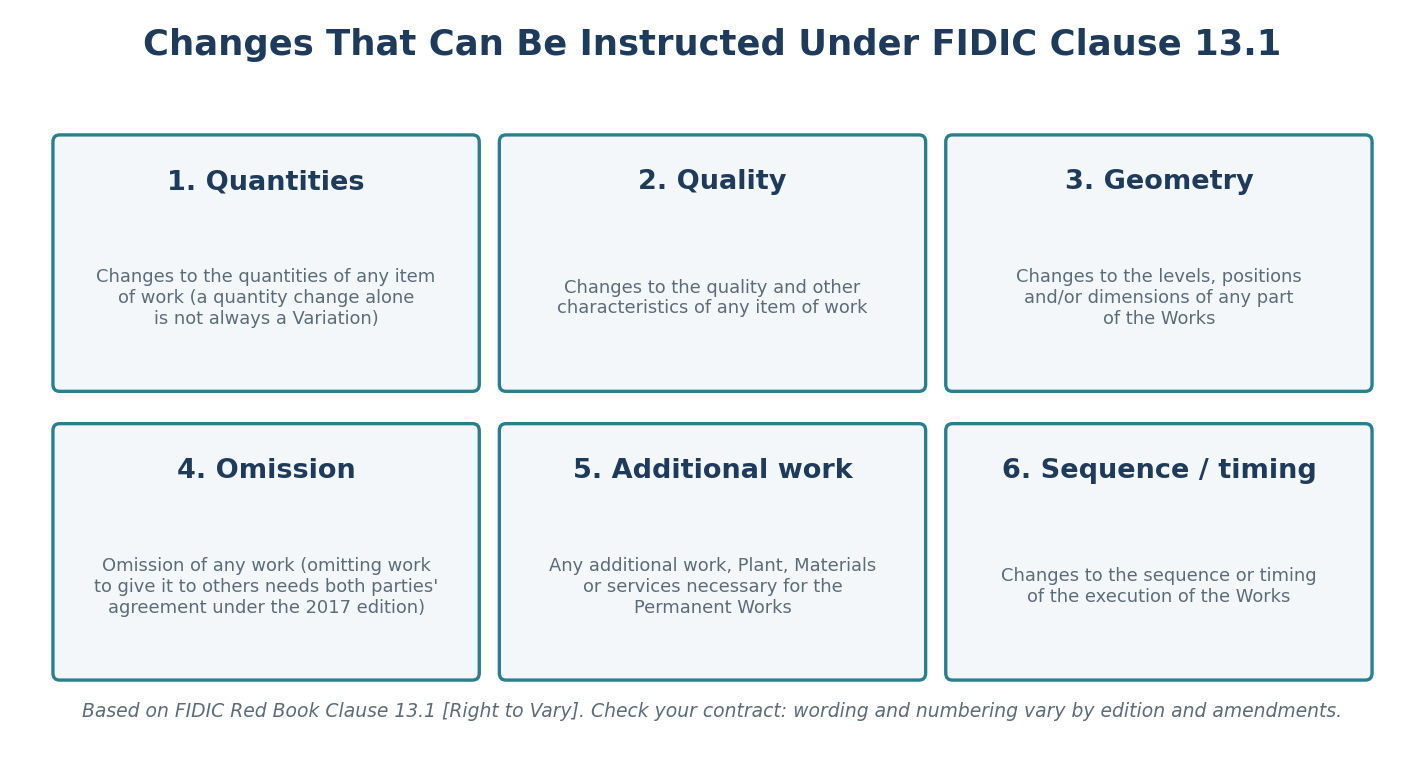
Clause 13.1 [Right to Vary] of the FIDIC Red Book (the numbering is the same in the 1999 and 2017 editions) lists the types of changes that may be instructed as a Variation:
- Changes to the quantities of any item of work included in the contract. Note that a change in quantity by itself does not necessarily constitute a Variation.
- Changes to the quality and other characteristics of any item of work.
- Changes to the levels, positions and/or dimensions of any part of the Works.
- Omission of any work. However, work cannot simply be taken away from the contractor to be given to the employer or to others; under the 2017 edition this requires the agreement of both parties.
- Any additional work, Plant, Materials or services necessary for the Permanent Works, including associated testing or exploratory work.
- Changes to the sequence or timing of the execution of the Works.
Variations may be initiated at any time before the Taking-Over Certificate for the Works is issued. The contractor has no right to change the Permanent Works on its own; it needs a Variation.
5. Who Can Instruct a Variation, and How?
Only the party named in the contract, usually the Engineer under FIDIC contracts, can initiate a Variation. Instructions from any other person, however senior they may appear on site, carry a real risk of non-payment if the named procedure is not followed.
Under the FIDIC Red Book, Second Edition 2017, a Variation can be initiated in two ways:
- Variation by Instruction (Sub-Clause 13.3.1): The Engineer issues a Notice describing the required change. The contractor must proceed with the varied work and, within 28 days of receiving the instruction (or another agreed period), submit detailed particulars: a description of the varied work with resources and methods, the effect on the programme and Time for Completion, and a priced proposal valued under Clause 12, including any time-related cost.
- Variation by Request for Proposal (Sub-Clause 13.3.2): The Engineer first requests a proposal. The contractor responds as soon as practicable, either with a proposal or with reasons why it cannot comply. Work is not delayed while the proposal is considered. If the Engineer consents, the Engineer then instructs the Variation.
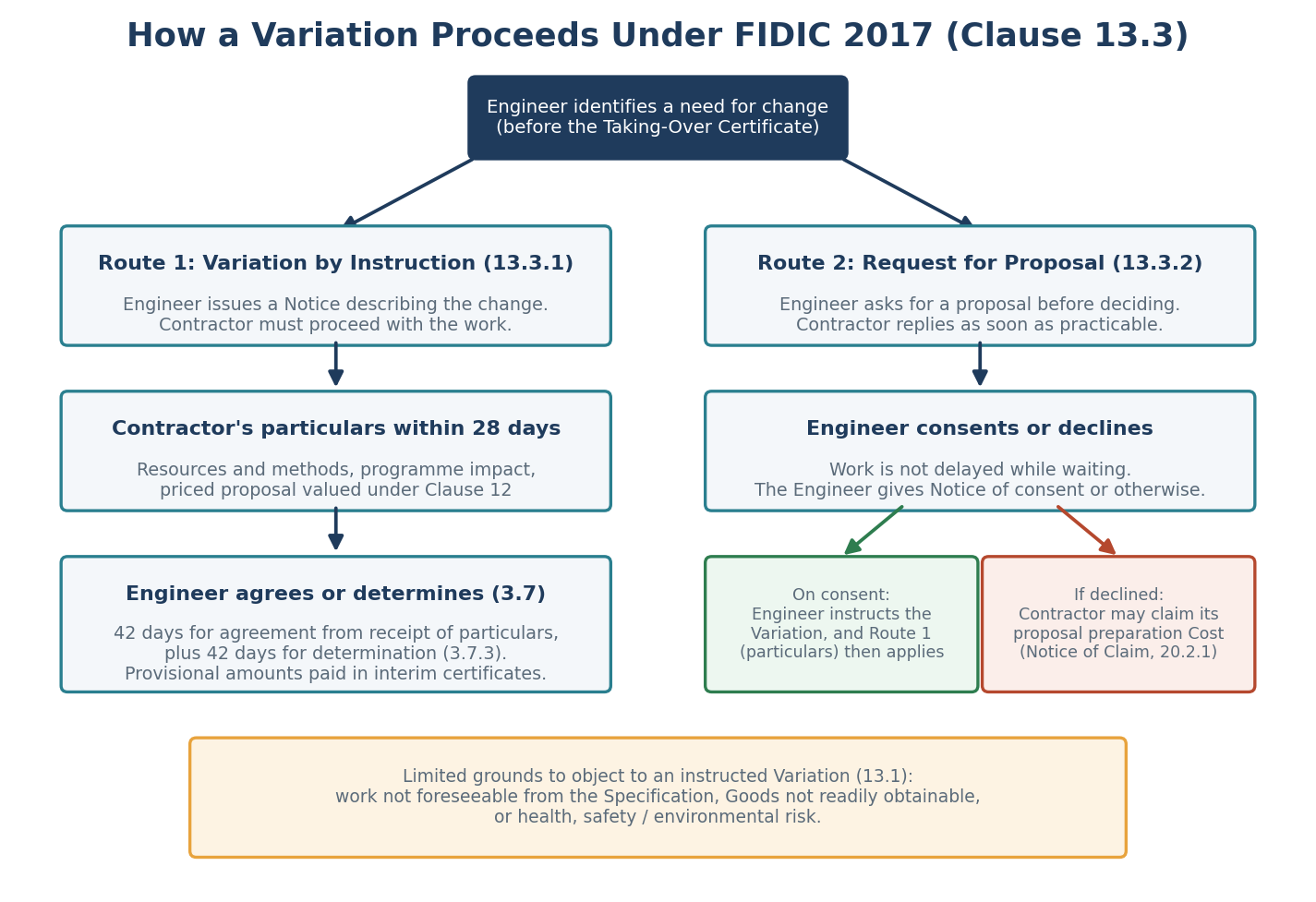
Under the 2017 edition, the Engineer then consults with the parties to reach agreement on the extension of time, if any, and the adjustment to the Contract Price (Sub-Clause 3.7.1), or, failing agreement, makes a fair determination (Sub-Clause 3.7.2). Under Sub-Clause 3.7.3 [Time Limits], the Engineer has 42 days from receipt of the contractor’s particulars to give Notice of agreement, and a further 42 days after that period to give Notice of determination, unless the parties agree other periods. If the Engineer misses these limits for a matter such as a variation valuation, the matter is deemed to be a Dispute that either party may refer to the Dispute Avoidance/Adjudication Board. Until the matter is settled, the Engineer includes a provisional amount in the interim payment certificates. In the 1999 edition, the corresponding mechanism is the Engineer’s determination under Sub-Clause 3.5.
The contractor’s grounds for objecting to an instructed variation are limited, for example where the varied work was not foreseeable from the contract, where the required goods are not readily obtainable, or where the change would conflict with health, safety or environmental obligations. If the Engineer issues an instruction that amounts to a variation but is not labelled as one, the contractor should notify the Engineer in writing and keep the contractual record straight.
Contractors may also propose beneficial changes themselves under Sub-Clause 13.2 [Value Engineering], for example proposals that accelerate completion, reduce cost or improve efficiency or value for the employer.
6. How Are Variations Valued?
Under FIDIC contracts, varied work is valued under Clause 12 [Measurement and Valuation]. The general approach is:
- Work of the same or similar character, executed under similar conditions, is measured at the contract rates.
- Work of a similar character but under different conditions may be valued at rates derived from the contract rates.
- Work of a different character, or for which no contract rate is suitable, is valued at a new rate derived from the cost of execution plus reasonable overheads and profit.
- Where work cannot be measured in advance, it may be recorded and paid on a daywork basis (Sub-Clause 13.5 of the 2017 edition; Sub-Clause 13.6 of the 1999 edition).
- Provisional Sums, if any, are expended against the Engineer’s instructions (Sub-Clause 13.4 of the 2017 edition; Sub-Clause 13.5 of the 1999 edition).
A word of caution on editions: the clause numbering and some procedures differ between the FIDIC 1999 and 2017 editions. For example, the detailed 28-day particulars requirement discussed above is a feature of the 2017 procedure, while the 1999 edition follows a simpler instruction and proposal mechanism under Sub-Clauses 13.1 to 13.3. Particular conditions of individual contracts frequently amend these provisions further, so the actual contract must always be checked.
7. Worked Example: Instructed Variation on a Road Project
Consider a road construction contract with the following details:
| Particulars | Details |
|---|---|
| Contract value | Rs. 10 crore |
| Contract conditions | FIDIC-based, 2017 procedure assumed |
| Change instructed | 600 cum of M20 concrete retaining wall, not included in the BOQ |
| Reason | Slope protection found necessary at a hill stretch |
| Contract rate available? | No matching rate in the contract |
| Derived rate (illustrative) | Rs. 7,200 per cum from first-principles analysis |
| Assessed time effect (illustrative) | 20 days EOT with time-related cost, as assessed by the contractor; subject to substantiation and to agreement or determination under Sub-Clause 3.7 |
How the variation proceeds under the 2017 procedure:
- Step 1: The Engineer issues a Notice instructing the additional retaining wall work under Sub-Clause 13.3.1.
- Step 2: The contractor proceeds with the work and, within 28 days, submits particulars covering the method and resources, the assessed programme effect (20 days with time-related cost, to be substantiated) and the priced proposal.
- Step 3: Price adjustment proposed = 600 cum x Rs. 7,200 per cum = Rs. 43.2 lakh. The price adjustment and the EOT are not automatic; they take effect only when agreed by the parties or determined by the Engineer under Sub-Clause 3.7.
- Step 4: Until agreement or determination, a provisional amount is included in the interim payment certificates.
- Step 5: The records of quantities, resources and progress are maintained jointly so the final valuation can be settled on evidence.
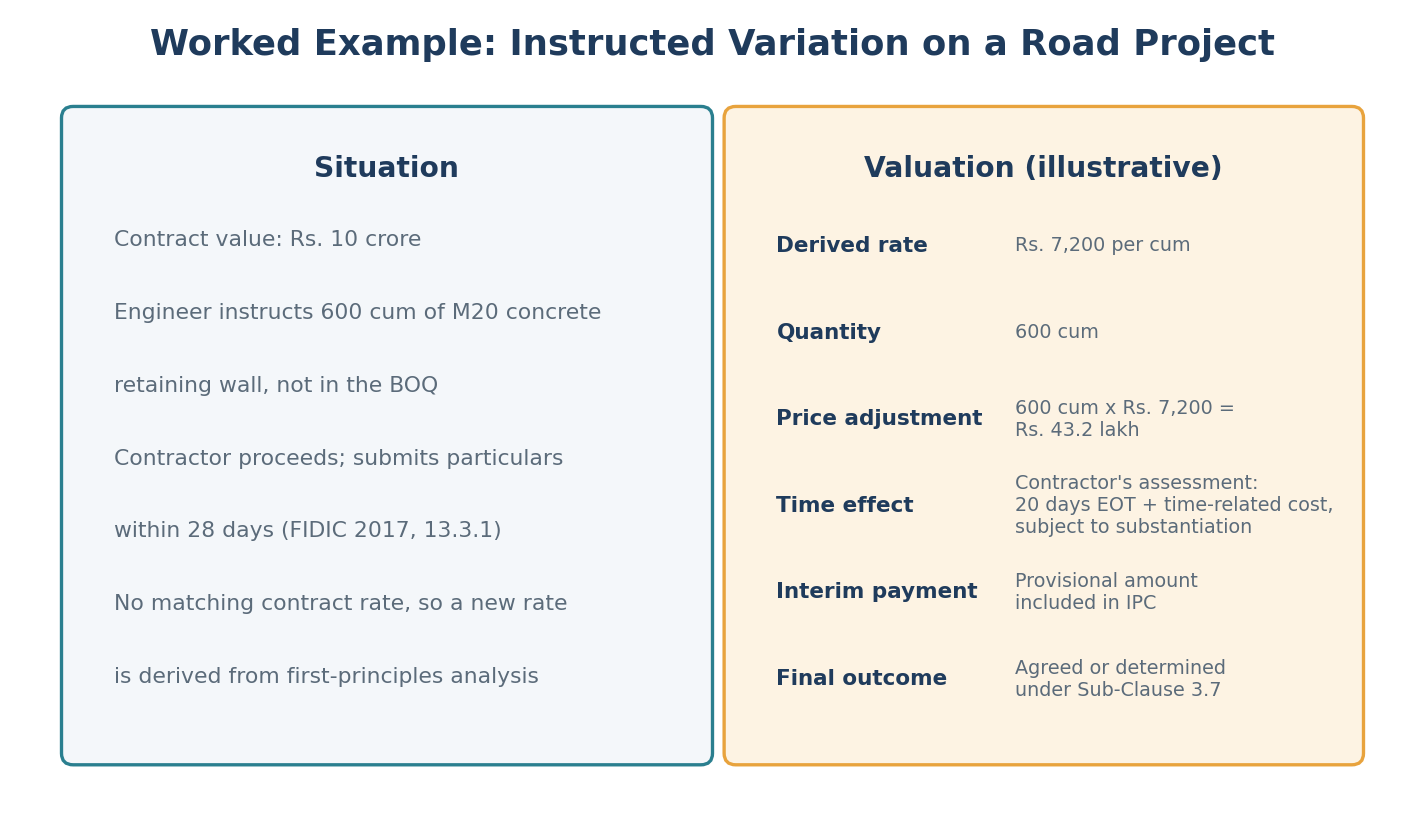
Important: The rates and time effects in this example are illustrative only. Actual valuation depends on the contract rates, the conditions under which the work is executed, and the applicable contract conditions.
8. Common Mistakes and Practical Precautions
Variation disputes often turn on procedure rather than on the change itself. The following precautions are useful on both sides:
- Treat verbal instructions with care. Secure written confirmation promptly from the authorised person, follow the contract’s own confirmation procedure and start your own written record immediately. Under FIDIC 1999 Sub-Clause 3.3, for example, an oral instruction confirmed in writing by the contractor within two working days becomes the written instruction unless the Engineer rejects it within two further working days; the 2017 edition requires instructions to be in writing.
- Watch for unlabelled variations. An instruction on drawings, levels or specifications that changes the Works may be a variation even if it is not called one. Notify the Engineer in writing.
- Record the time effect at the point of instruction, even provisionally. Time effects left to be settled later are a frequent cause of disputes and liquidated damages exposure.
- Mind the notice periods. If a variation dispute has to be pursued as a claim, the contractor’s notice is due within 28 days of becoming aware of the event (Sub-Clause 20.2.1 of the 2017 edition; Sub-Clause 20.1 of the 1999 edition). Missing it can extinguish the entitlement.
- Keep contemporary records: daily reports, labour and plant returns, dated photographs, delivery notes and measurement sheets.
- Maintain a variation register showing status, value and time impact of every instruction.
- Check the particular conditions of the contract, which may shorten time limits, add approval thresholds or modify the valuation rules.
9. Variations in Indian Public Works Contracts
In Indian government works contracts, the corresponding mechanism is often described as deviations and extra or substituted items. For example, the CPWD General Conditions of Contract 2023 (Construction Works) deals with deviations and variations, their extent and pricing under Clause 12, and the rates for extra items are generally settled through market-rate analysis. The applicable edition of the GCC must always be checked, as clause numbering and procedure change between editions.
The underlying discipline is the same as under FIDIC: a written order from the authorised engineer, timely submission of rate analysis and supporting particulars by the contractor, and a determination by the engineer-in-charge within the contractual framework. Whatever the form of contract, the contractor’s protection lies in written instructions, prompt notices and contemporary records.
Conclusion
A variation order and a change order serve the same broad purpose: they modify a construction contract after it has been signed. The variation is the term used in FIDIC and most international and Commonwealth contracts, where the Engineer instructs the change and the price and time effects are settled under the contract’s valuation rules. The change order is the usual term in US-style administration, where the change is more often agreed and priced before it is signed.
Under FIDIC Clause 13, the Engineer may instruct changes to quantities, quality, geometry, sequence or timing, omit work, or order additional work, and the contractor is generally bound to proceed. Under the 2017 procedure, the contractor’s detailed particulars are due within 28 days of an instruction, and the Engineer agrees or determines the time and price effects under Sub-Clause 3.7.
For employers, engineers and contractors alike, the safeguards are consistent across forms of contract: written instructions from the authorised person, prompt notices within the contractual time limits, and disciplined contemporary records. These habits, more than anything else, decide whether a change is settled smoothly or turns into a dispute.
Read also
- Extension of Time (EOT) in Construction Contracts: What It Is and How It Works
- What Are Liquidated Damages in Construction Contracts and How Are They Calculated? (With Example)
- What Is an RFI in Construction? How to Write One (With a Worked Example)
References and Further Reading
- FIDIC, Conditions of Contract for Construction (Red Book), Second Edition 2017, Clause 13 [Variations and Adjustments] and Sub-Clause 3.7 [Agreement or Determination]; and the First Edition 1999, Clauses 3.3, 3.5 and 13.
- Ramskill Martin, A Contractor’s Overview of Change Management under the FIDIC Red Book Second Edition 2017: https://ramskillmartin.co.uk/technical/a-contractors-overview-of-change-management-under-the-fidic-red-book-second-edition-2017
- imHORA contract guides to the FIDIC Red Book 2017, Clause 13 and Clause 3: https://imhora.com/contract-guides/fidic-red-book-2017/clause-13/ and https://imhora.com/contract-guides/fidic-red-book-2017/clause-3/
- AIA Contract Documents, Construction Change Directive vs Change Order: https://learn.aiacontracts.com/articles/construction-change-directive-vs-change-order/ and Instructions, G701-2017 Change Order: https://help.aiacontracts.com/hc/en-us/articles/1500009322061-instructions-g701-2017-change-order
- CPWD, General Conditions of Contract 2023 (Construction Works), Clause 12 [Deviations/Variations Extent and Pricing]: https://iitk.ac.in/iwd/file/2025/01-AC-EE-2025/GCC2023.pdf
Rajesh Pant is a Civil Engineer and Infrastructure Management professional with approximately 25 years of experience in the planning, implementation, coordination, management and execution of large-scale government infrastructure projects. His professional experience encompasses project management, procurement, contract administration, construction management and quality control of infrastructure projects. He also possesses nearly eight years of experience in Externally Aided Projects (EAPs), particularly in project implementation, procurement and contract management of World Bank-funded projects. His professional exposure includes working with projects financed by multilateral development organisations, providing valuable insights into international procurement practices, project implementation frameworks and contract management requirements. He holds a Master of Technology (M.Tech.) in Civil Engineering and a Master of Business Administration (MBA) in Infrastructure Management, combining technical engineering expertise with management and administrative capabilities. With extensive experience in public infrastructure development and government project management, Rajesh brings a practical, multidisciplinary perspective to the fields of contract management, procurement, project management and construction management.