What Are Liquidated Damages in Construction Contracts and How Are They Calculated? (With Example)
Table of contents
- 1. What Are Liquidated Damages?
- 2. Why Are Liquidated Damages Included in Construction Contracts?
- 3. How Are Liquidated Damages Calculated?
- 4. What Is the Difference Between Liquidated Damages and Penalty?
- 5. Legal Position in India: Section 74 of the Indian Contract Act, 1872
- 6. Liquidated Damages under FIDIC Contracts
- 7. Important Precautions While Drafting an LD Clause
- Conclusion
Construction projects are required to be completed within a specified contractual period. However, delays may occur due to inadequate planning, shortage of resources, poor performance, or other reasons attributable to the contractor.
To protect the employer against the financial consequences of such delays, construction contracts generally include a provision for Liquidated Damages (LD).
Liquidated damages are a pre-agreed amount of compensation payable by one party to another in the event of a specified contractual breach, such as failure to complete the project within the stipulated time.
This article explains the meaning of liquidated damages, their calculation, a practical construction example, and the difference between liquidated damages and penalty.
1. What Are Liquidated Damages?
Liquidated damages are amounts agreed upon by the parties at the time of entering into a contract as a reasonable estimate of the loss likely to arise from a specified breach of contract.
In construction contracts, liquidated damages are commonly imposed when the contractor fails to complete the works within the contractual completion period, after accounting for any valid Extension of Time (EOT).
For example, suppose a road construction contract provides for liquidated damages of Rs. 50,000 per day for delay beyond the stipulated completion date, subject to a maximum of 10% of the contract value.
If the contractor completes the work 20 days late, the employer may calculate LD according to the agreed contractual rate, subject to the applicable conditions and maximum limit.
The purpose is to provide a predetermined method of compensation without having to calculate the employer’s loss from the beginning after every delay.
2. Why Are Liquidated Damages Included in Construction Contracts?
Liquidated damages serve several important purposes:
- Compensation for delay: They provide a contractual mechanism for compensating the employer for qualifying delays.
- Certainty: The parties know in advance the financial consequences of a specified breach.
- Risk allocation: They allocate the financial risk of delay between the employer and contractor.
- Avoidance of disputes: A predetermined rate can reduce disagreements over the calculation of delay-related losses.
- Contractual discipline: They encourage contractors to plan and execute work within the agreed completion period.
The agreed amount should be reasonable and proportionate to the anticipated loss, rather than designed merely to punish the contractor.
3. How Are Liquidated Damages Calculated?
Liquidated damages in construction contracts are generally calculated using a daily, weekly, or other periodic rate specified in the contract.
The common formula is:
Liquidated Damages = Applicable LD Rate × Number of Delay Days
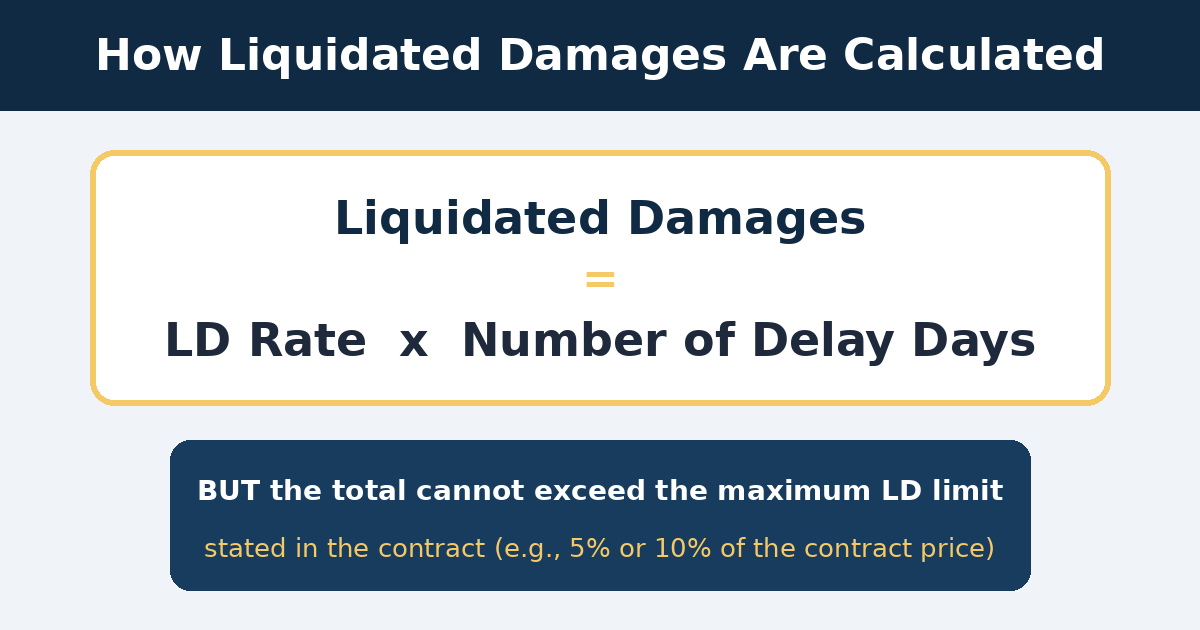
However, the amount payable cannot exceed the maximum LD limit prescribed in the contract.
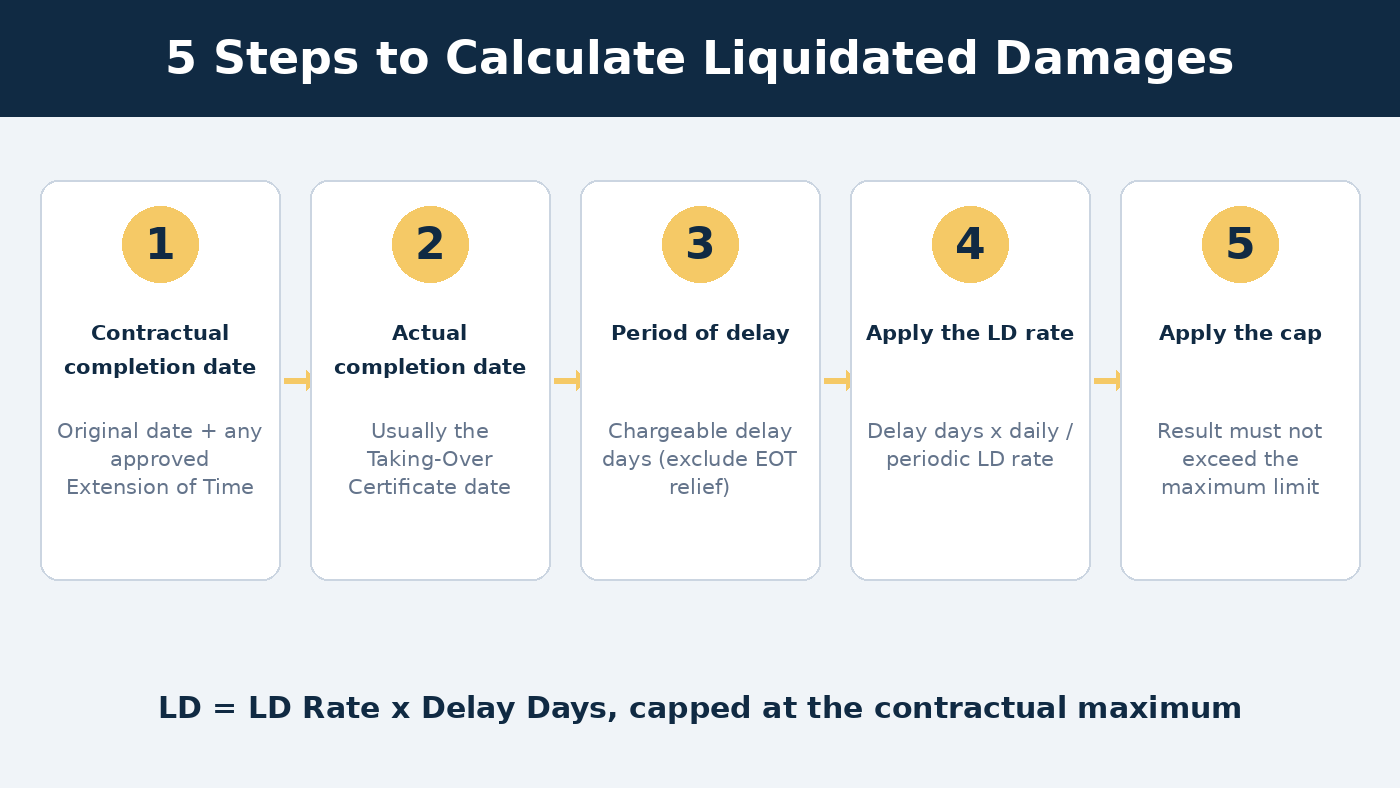
The calculation generally involves the following steps:
Step 1: Determine the contractual completion date
Identify the original completion date and any revised completion date granted through an approved Extension of Time.
Step 2: Determine the actual completion date
Establish the date on which the works or relevant section achieved the contractual completion milestone, generally evidenced by the Taking-Over Certificate or equivalent contractual certification.
Step 3: Calculate the period of delay
Calculate the number of days between the applicable completion date and the actual completion date, excluding periods for which the contractor is contractually entitled to relief.
Step 4: Apply the agreed LD rate
Multiply the number of chargeable delay days by the daily or periodic LD rate stated in the contract.
Step 5: Apply the maximum limit
Check the contractual cap, such as 5% or 10% of the contract price. The amount calculated must not exceed the applicable maximum.
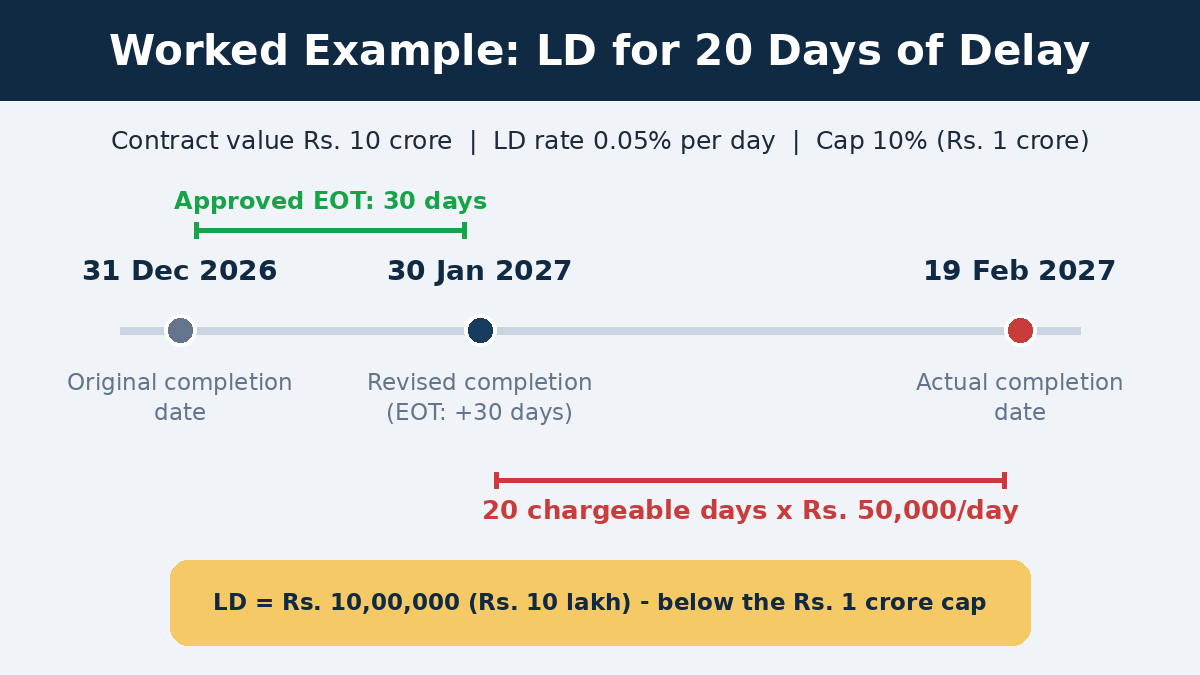
Worked Example: Calculation of Liquidated Damages
Consider a road construction project with the following contract details:
| Particulars | Amount / Period |
|---|---|
| Contract value | Rs. 10 crore |
| Original completion period | 12 months |
| Original completion date | 31 December 2026 |
| Approved EOT | 30 days |
| Revised completion date | 30 January 2027 |
| Actual completion date | 19 February 2027 |
| LD rate | 0.05% of contract value per day |
| Maximum LD limit | 10% of contract value |
Calculation:
- Revised completion date: 30 January 2027.
- Actual completion date: 19 February 2027.
- Delay beyond revised completion date: 20 days.
- Daily LD: Rs. 10 crore × 0.05% = Rs. 50,000.
- Total LD: Rs. 50,000 × 20 days = Rs. 10,00,000.
Liquidated Damages = Rs. 10 lakh
The maximum permissible LD under this example is Rs. 1 crore (10% of the contract value). Since the calculated amount is below the cap, the amount considered under the contract is Rs. 10 lakh, subject to the applicable contractual and legal requirements.
Important: The example assumes that the entire 20-day period is chargeable to the contractor and that no further EOT or contractual relief is applicable.
4. What Is the Difference Between Liquidated Damages and Penalty?
Although the terms liquidated damages and penalty are sometimes used interchangeably, they have different purposes in contract law.
Liquidated damages are intended to represent a genuine and reasonable pre-estimate of the loss likely to arise from a breach of contract.
A penalty is an amount imposed primarily to punish or deter a party from breaching the contract, rather than to reasonably compensate the injured party.
The distinction can be understood through the following table:
| Basis | Liquidated Damages | Penalty |
|---|---|---|
| Purpose | Compensation for anticipated loss | Punishment or deterrence |
| Basis of calculation | Reasonable estimate of probable loss | May be arbitrary or excessive |
| Proportionality | Generally proportionate to anticipated loss | May be disproportionate |
| Contractual intention | Compensatory | Punitive |
| Legal treatment | May be enforceable subject to applicable law | May be restricted or reduced by courts |
Example
Suppose the employer expects that a delay in completing a highway project may cause additional supervision costs, administrative expenses, and other financial consequences.
The parties agree on Rs. 50,000 per day as a reasonable estimate of the likely loss.
This may constitute a liquidated damages provision.
However, if the contract imposes Rs. 10 lakh per day for every day of delay without any reasonable relationship to the anticipated loss, the provision may be regarded as penal in nature, depending on the circumstances.
5. Legal Position in India: Section 74 of the Indian Contract Act, 1872
In India, liquidated damages and penalty clauses are primarily governed by Section 74 of the Indian Contract Act, 1872.
Section 74 provides that where a contract names a sum payable in case of breach, or contains a stipulation by way of penalty, the party complaining of the breach is entitled to reasonable compensation, not exceeding the amount named in the contract.
Some important principles are:
- The amount stated in the contract is the maximum limit, not necessarily the amount automatically recoverable.
- The compensation awarded must be reasonable.
- Where actual loss can be established, evidence of such loss is generally relevant.
- Where loss is difficult or impossible to quantify precisely, a genuine pre-estimate may provide a reasonable basis for compensation.
- A party cannot use an LD clause to obtain an unjustified financial benefit.
In ONGC Ltd. v. Saw Pipes Ltd. (2003) 5 SCC 705, the Supreme Court recognised that where the stipulated amount represents a genuine pre-estimate of loss and actual loss is difficult to prove, the agreed amount may be awarded as reasonable compensation, subject to Section 74.
In Kailash Nath Associates v. Delhi Development Authority (2015) 4 SCC 136, the Supreme Court reiterated that Section 74 does not permit automatic or unreasonable recovery merely because a sum has been mentioned in the contract. The party claiming compensation must establish the relevant breach and entitlement, and the compensation must be reasonable.
Therefore, in India, merely describing a contractual amount as ‘liquidated damages’ does not make it automatically recoverable.
6. Liquidated Damages under FIDIC Contracts
FIDIC Conditions of Contract also provide for delay damages.
- FIDIC 1999 Red Book – Sub-Clause 8.7: Provides for Delay Damages where the contractor fails to comply with the Time for Completion. The applicable daily amount and maximum limit are stated in the Appendix to Tender.
- FIDIC 2017 Red Book – Sub-Clause 8.8: Contains the corresponding provision for Delay Damages, with the applicable amount and maximum limit specified in the Contract Data.
Under these provisions, delay damages are generally calculated for each day between the applicable Time for Completion and the date stated in the Taking-Over Certificate, subject to the contractual maximum.
The contractor’s liability must be assessed after considering any entitlement to Extension of Time under the relevant provisions. The applicable claims and notice procedures must also be followed.
7. Important Precautions While Drafting an LD Clause
While preparing construction tender documents, the employer should consider the following:
- Specify the LD rate clearly, whether daily, weekly, or otherwise.
- Define the basis of calculation, such as the contract price or value of the delayed section.
- Prescribe a reasonable maximum LD limit.
- Clearly define the applicable completion milestone.
- Provide for adjustment of the completion date where EOT is granted.
- Ensure that the clause is consistent with the applicable contract conditions and governing law.
- Follow the contractual procedure for notifying and determining the employer’s claim.
Conclusion
Liquidated damages are an important contractual mechanism in construction projects for addressing delays and compensating the employer for anticipated losses arising from failure to meet contractual obligations.
They are generally calculated by applying a pre-agreed rate to the number of chargeable delay days, subject to the maximum limit specified in the contract.
The key distinction between liquidated damages and penalty is that liquidated damages are intended to provide reasonable compensation, whereas a penalty is primarily punitive. Under Indian law, Section 74 of the Indian Contract Act requires reasonable compensation and does not make the full stipulated amount automatically payable.
Proper drafting and fair administration of LD provisions help protect the employer’s interests while ensuring that contractors are not subjected to arbitrary or excessive financial liability.
Rajesh Pant is a Civil Engineer and Infrastructure Management professional with approximately 25 years of experience in the planning, implementation, coordination, management and execution of large-scale government infrastructure projects. His professional experience encompasses project management, procurement, contract administration, construction management and quality control of infrastructure projects. He also possesses nearly eight years of experience in Externally Aided Projects (EAPs), particularly in project implementation, procurement and contract management of World Bank-funded projects. His professional exposure includes working with projects financed by multilateral development organisations, providing valuable insights into international procurement practices, project implementation frameworks and contract management requirements. He holds a Master of Technology (M.Tech.) in Civil Engineering and a Master of Business Administration (MBA) in Infrastructure Management, combining technical engineering expertise with management and administrative capabilities. With extensive experience in public infrastructure development and government project management, Rajesh brings a practical, multidisciplinary perspective to the fields of contract management, procurement, project management and construction management.