GeM Bidding Process for Sellers: How to Participate in a GeM Bid (Step-by-Step)
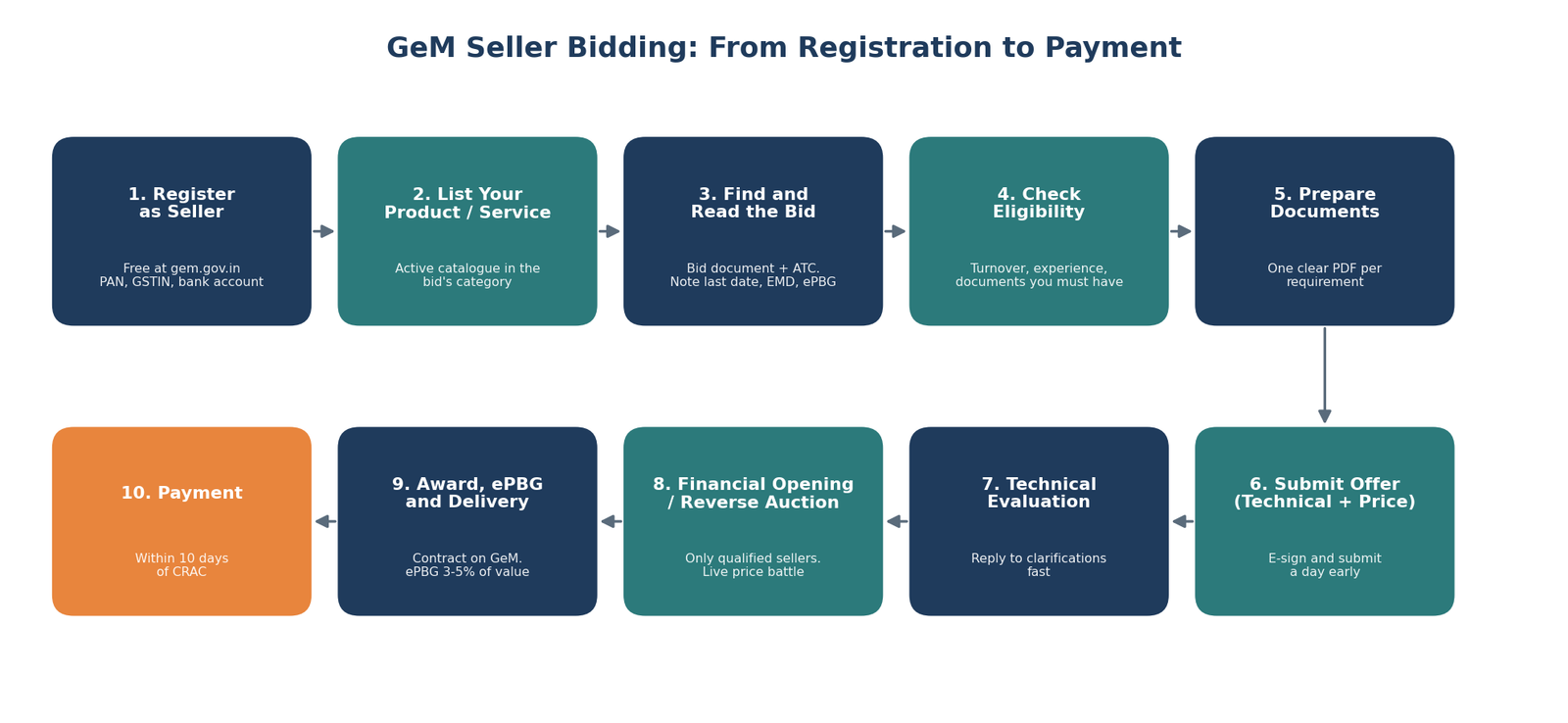
Table of contents
- 1. How buying happens on GeM (so you know where bids fit)
- 2. Before you can bid: three things must be ready
- 3. Know the bid types
- 4. Step by step: how to participate in a GeM bid
- 5. After submission: evaluation and the reverse auction
- 6. After you win: ePBG, delivery and payment
- 7. Documents checklist for GeM bidding
- 8. Common mistakes that get GeM bids rejected
- 9. Practical tips to win more GeM bids
- 10. Frequently asked questions
- Conclusion
Every day, government departments, PSUs and autonomous bodies publish thousands of bids on the Government e-Marketplace (GeM). For a registered seller, these bids are the road to the biggest government orders – the ones above Rs. 10 lakh, where competitive bidding is compulsory. Yet many sellers never participate because the process looks complicated from the outside. It is not. Once you understand the flow, bidding on GeM becomes a repeatable routine. This guide explains the complete GeM bidding process for sellers, step by step, with the rules that matter at each stage.
1. How buying happens on GeM (so you know where bids fit)
Under GFR Rule 149 (as amended in July 2024), a government buyer purchases through GeM in three ways:
| Purchase method | Order value | How it works |
|---|---|---|
| Direct purchase | Up to Rs. 50,000 | Buyer picks any available seller meeting quality, specification and delivery needs. |
| L1 comparison purchase | Rs. 50,000 to Rs. 10 lakh | Buyer compares products of at least 3 different OEMs and buys from the lowest-priced (L1) seller. |
| Bids and Reverse Auctions (RA) | Above Rs. 10 lakh (compulsory). Buyers may use bidding even above Rs. 50,000 | Sellers compete through an online bid; the price may be settled by a live reverse auction. |
This article is about the third method – bids and reverse auctions – because that is where the large orders are, and where a prepared seller wins.
2. Before you can bid: three things must be ready
- Seller registration on GeM (free). You need the PAN of the business, GSTIN where applicable, a bank account in the firm's name and Aadhaar verification of the authorised person. If you are not registered yet, follow our step-by-step GeM registration guide (link below).
- An active catalogue. For products, your item must be listed in the right category with specifications and price; for services, you need a service offering. GeM matches sellers to bids through categories – no listing in the bid's category usually means you cannot participate.
- OEM authorisation, if you are a reseller. Many bids ask the reseller for an authorisation letter from the Original Equipment Manufacturer. A missing OEM authorisation is one of the most common reasons a GeM bid gets rejected. Some categories also require the OEM to pass a vendor assessment before listing.
3. Know the bid types
- Single-stage bid: technical offer and price submitted together in one packet flow.
- Two-packet bid: the technical bid is evaluated first; your price is opened only if you qualify technically.
- Bid-to-RA: a normal bid first, then technically qualified sellers fight a live reverse auction on price.
- BOQ-based bids: item-wise (schedule-wise) rates. If the evaluation is schedule-wise, you can quote for selected schedules only.
- PAC (Proprietary Article Certificate) bids: only sellers offering the specified make and model can participate.
4. Step by step: how to participate in a GeM bid
Step 1: Find the right bid
Open the Bids and RA section on gem.gov.in, filter by your category and search by keywords. GeM must publish a bid at least 10 clear days before the last date of submission, but do not wait – plan your work backwards from the closing date and time.
Step 2: Read the bid document and the ATC completely
Note the end date and time, eligibility conditions (turnover and experience), EMD, the ePBG percentage, delivery period and consignee locations. GeM has capped the turnover a buyer can demand at 0.5 times the estimated bid value. Read the buyer's Additional Terms and Conditions (ATC) with the same care as the main document – the ATC is equally binding. If something is unclear, use the pre-bid query facility before its deadline.
Step 3: Check eligibility honestly
If you do not meet a condition, do not bid and hope. Arrange the missing document – an OEM authorisation, a certificate – in time for the next suitable bid instead.
Step 4: Arrange the EMD (or claim your exemption)
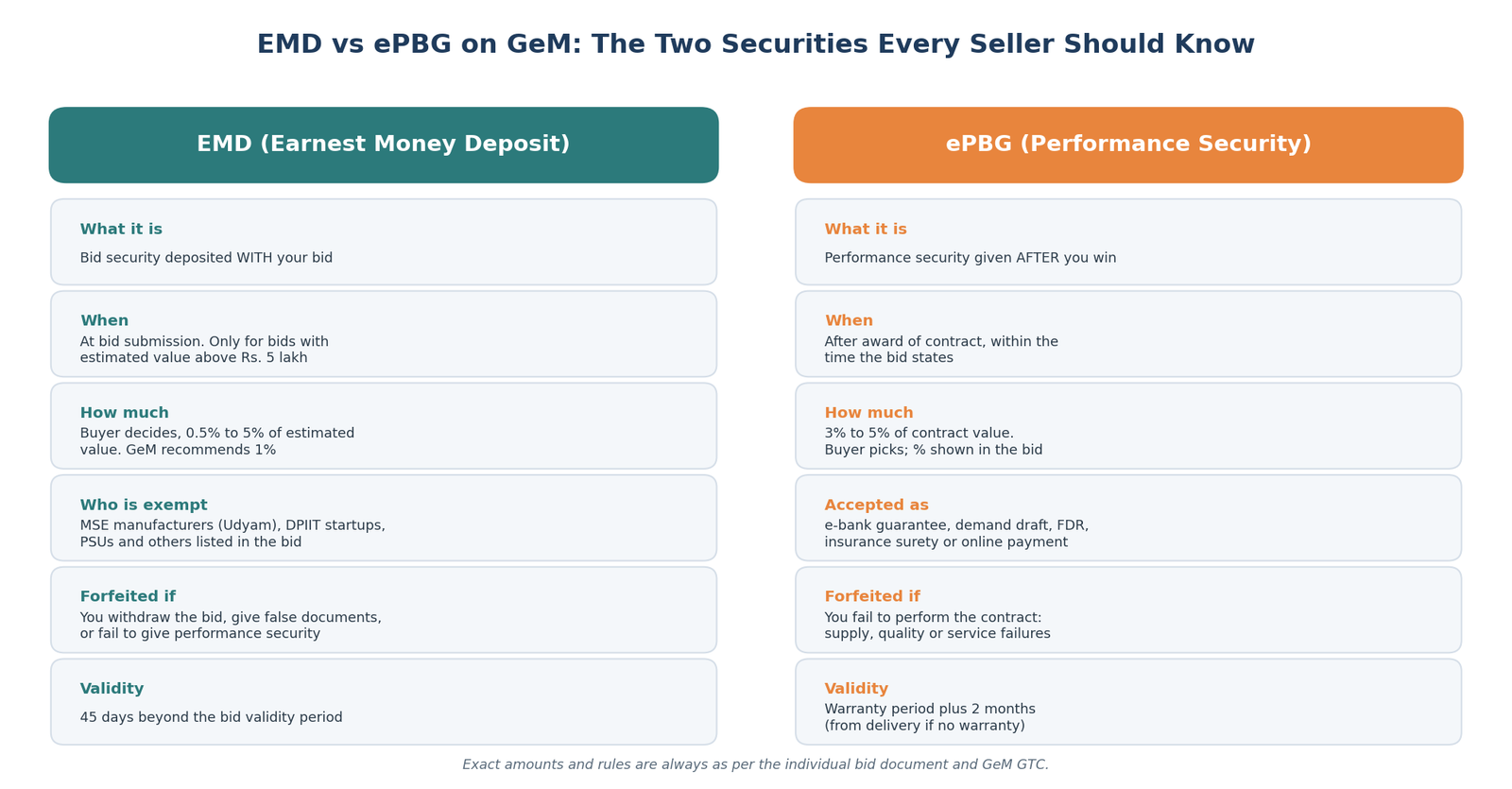
- No bid security (EMD) is taken for bids or RAs with an estimated value below Rs. 5 lakh.
- For larger bids, the buyer fixes the EMD between 0.5% and 5% of the estimated value. GeM recommends 1%.
- Exempt: MSE manufacturers holding valid Udyam registration, DPIIT-recognised startups, PSUs and certain other categories listed in the bid. Claim the exemption only with valid proof.
- Many bids accept a Bid Securing Declaration instead of EMD, as per Department of Expenditure instructions.
- Your EMD is forfeited if you withdraw your bid within its validity, submit false documents, or fail to furnish performance security after winning.
Step 5: Prepare documents in the upload order
Make one clear PDF per requirement, named for what it proves (for example, "Turnover CA certificate FY 2023-25"). Scan so stamps and signatures are readable. Sign every declaration on your letterhead with the date and bid number. Do not forget the documents the ATC asks for – a missing ATC document is treated the same as a missing standard document.
Step 6: Fill the technical offer
Select your catalogue, confirm compliance item by item against the bid specification, and state the maximum quantity you can supply with the delivery period. Never mention your price anywhere in the technical bid.
Step 7: Fill the financial offer
Enter your rates in the format the bid asks – including GST (forward or reverse charge), freight and CMC charges where applicable. Important: once you encrypt and save your price, it cannot be changed. Check it twice before saving.
Step 8: E-sign and submit
Sign the bid electronically – the portal offers OTP, Aadhaar e-sign or a digital signature certificate (DSC) – and submit. Submit at least a day before the closing time; portal load is highest in the final hours, and a failed last-minute upload cannot be argued afterwards. Download and keep the submission acknowledgement.
5. After submission: evaluation and the reverse auction
- The buyer opens the technical bids first. Watch your GeM dashboard and email every day – the buyer can ask for clarifications with a short response deadline, and a missed clarification can turn a qualified bid into a rejected one.
- If your bid is disqualified, GeM shows the reason. Where a representation window is offered, use it to correct genuine evaluation errors with evidence – not to add documents you forgot.
- Financial bids are opened only for technically qualified sellers.
- If a reverse auction follows: the start price and the step value of decrement are shown to bidders. You can bid one or more steps below the prevailing lowest price. If a lower bid arrives in the last 15 minutes, the auction extends automatically by another 15 minutes.
- Your offer stays valid for 15 days from the bid opening date for a normal e-bid (30 days from the start of the auction in a Bid-to-RA), or as the bid document states.
- The contract goes to the lowest evaluated seller (L1), subject to MSE purchase preference where the bid provides it.
6. After you win: ePBG, delivery and payment
- The buyer generates the contract on GeM.
- Furnish the ePBG (performance security) within the stated time. The buyer picks 3% to 5% of the contract value, and the percentage is visible in the bid before you quote. It is accepted as an e-bank guarantee, demand draft, fixed deposit receipt, insurance surety bond or online payment where the bid allows. Keep it valid for the warranty period plus two months.
- Deliver to the consignees on schedule. The consignee inspects the supply and can accept or reject it within 10 days of receipt.
- On acceptance, the consignee issues the CRAC (Consignee's Receipt-cum-Acceptance Certificate) – the basis of your payment. Raise your online invoice on GeM.
- Payment: for goods, 100% payment is due within 10 days of the CRAC; for services, monthly bills are paid within 10 days of the Service Delivery Acceptance Certificate. Government instructions also charge penal interest on buyers for delayed payment.
- Your record follows you. On-time delivery and quality on this contract shape how buyers treat you on the next bid.
7. Documents checklist for GeM bidding
| Document | Why it is needed |
|---|---|
| PAN and GSTIN | Identity and tax registration of the firm |
| Udyam registration (for MSEs) | EMD exemption, experience/turnover relaxations, purchase preference |
| Bank account details / cancelled cheque | Receiving payments |
| OEM authorisation letter | Compulsory for resellers in many bids |
| CA-certified turnover certificate | Meeting the turnover eligibility condition |
| Experience proof / past order copies | Meeting the experience eligibility condition |
| EMD proof or exemption claim | Bid security |
| Make in India declaration (Class 1 / Class 2 supplier) | Purchase preference under the Make in India policy |
| Signed ATC and other declarations | Compliance with the bid's own terms |
8. Common mistakes that get GeM bids rejected
- Bidding without an active listing in the bid's category.
- Missing OEM authorisation for a reseller bid.
- Unreadable or unsigned documents – stamps, signatures and dates must be visible.
- Ignoring the ATC and answering only the standard requirements.
- Mentioning price anywhere in the technical bid.
- Claiming MSE or startup exemption without valid proof.
- Submitting in the last hour and losing to portal load.
- Missing a clarification request after submission.
9. Practical tips to win more GeM bids
- Set up your category and catalogue before you need them – not when a deadline is two days away.
- Study past awards on GeM to learn the winning prices before you quote.
- Bid only where you meet every eligibility condition.
- Quote sustainable prices. You cannot revise after encrypting, and a reverse auction will pull the price down further.
- Reply to clarifications the same day.
- Treat delivery timelines as contractual. Late delivery damages your GeM record and can invite liquidated damages.
10. Frequently asked questions
Is GeM seller registration free?
Yes. Registration is free. Individual bids may require EMD, and a winning bid requires ePBG. Some product categories also need an OEM vendor assessment, which carries its own charges.
Can I bid on GeM without listing a product?
Generally no. You need an active product listing or service offering in the bid's category, so set it up well before the deadline.
Do I need a digital signature certificate (DSC)?
Not necessarily. GeM lets you sign bids with OTP or Aadhaar-based e-sign, and also supports a DSC. Use whichever the portal offers for your account.
Can I change my price after submitting?
No – once you encrypt and save the price, it is locked. If you must correct it, withdraw and resubmit before the closing time. Withdrawing after opening can forfeit your EMD.
When is the financial bid opened?
After technical evaluation is complete, and only for technically qualified sellers. If the buyer enabled a reverse auction, it follows the financial opening.
Conclusion
GeM bidding rewards the prepared seller: the right category, a clean catalogue, complete documents, an honest eligibility check and an early submission. The first bid is the hardest; after that, the process becomes routine. If you are not registered on GeM yet, start with our step-by-step GeM registration guide, and come back to this article when your first bid invitation arrives.
Rajesh Pant is a Civil Engineer and Infrastructure Management professional with approximately 25 years of experience in the planning, implementation, coordination, management and execution of large-scale government infrastructure projects. His professional experience encompasses project management, procurement, contract administration, construction management and quality control of infrastructure projects. He also possesses nearly eight years of experience in Externally Aided Projects (EAPs), particularly in project implementation, procurement and contract management of World Bank-funded projects. His professional exposure includes working with projects financed by multilateral development organisations, providing valuable insights into international procurement practices, project implementation frameworks and contract management requirements. He holds a Master of Technology (M.Tech.) in Civil Engineering and a Master of Business Administration (MBA) in Infrastructure Management, combining technical engineering expertise with management and administrative capabilities. With extensive experience in public infrastructure development and government project management, Rajesh brings a practical, multidisciplinary perspective to the fields of contract management, procurement, project management and construction management.