Bank Guarantee (BG) Explained: Types, Validity, Encashment and Tender Rules
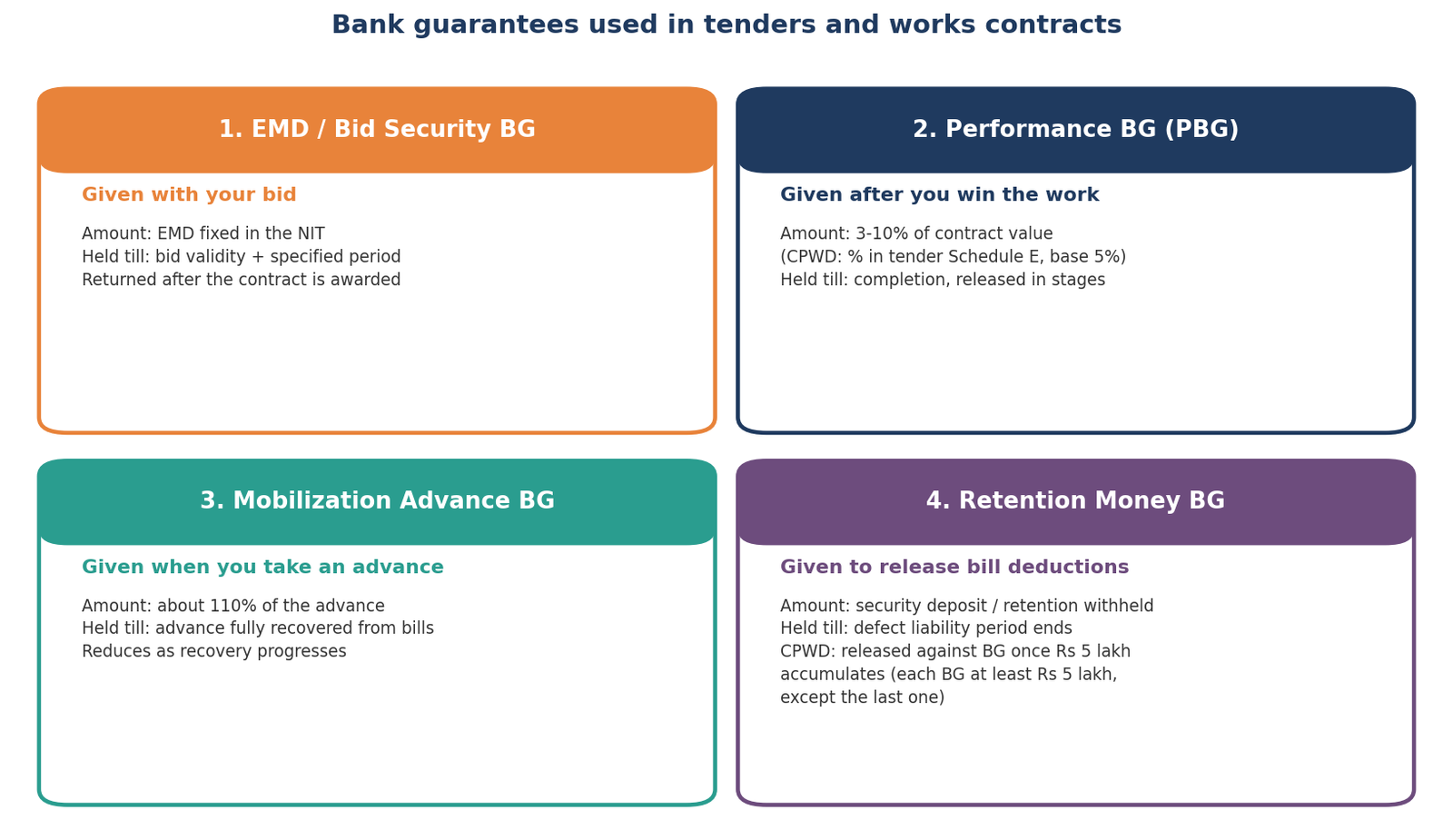
Table of contents
- 1. What is a bank guarantee?
- 2. The main types of bank guarantees in tenders
- 3. BG rules in MoRTH / NHAI highway contracts
- 4. BG vs EMD: clearing the confusion
- 5. What a bank guarantee contains
- 6. Encashment: what happens when the department invokes your BG
- 7. Validity, claim period and “extend or pay”
- 8. What does a bank guarantee cost?
- 9. Practical rules for contractors
- 10. A quick example
- Key takeaways
If you work on government tenders, you will deal with bank guarantees at every stage: with your bid, when you win, when you take an advance, and when your bill money is held back. Yet the humble BG is one of the most misunderstood documents in contracting. This article explains what a bank guarantee is, the types used in tenders, how validity and the claim period work, what happens on encashment, and the practical rules that protect your money, including the MoRTH/NHAI highway contract provisions.
1. What is a bank guarantee?
A bank guarantee is a written, unconditional promise by your bank to pay the department (the beneficiary) a fixed amount of money on first demand, if you (the applicant) fail to meet the obligation the guarantee secures.
The most important thing to understand: the BG is an independent contract between the bank and the department. When the department demands payment, the bank pays without deciding whether you actually defaulted. Your dispute with the department is a separate matter, to be settled later.
2. The main types of bank guarantees in tenders
Four types cover almost every tender and works contract:
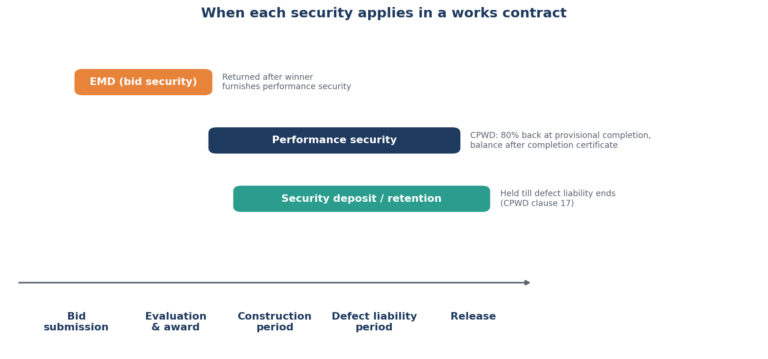
- EMD / bid security BG. Furnished with the bid, where the bid document allows EMD in BG form. It stays valid through the bid validity period plus any extra period specified. It is returned after the contract is awarded and the winner furnishes his performance security.
- Performance BG (PBG). Furnished after you win, as the performance security for the contract. GFR limits: 3-10 per cent of contract value for works, 3-5 per cent for goods and services. In CPWD tenders the percentage in the tender’s Schedule E governs (the base GCC proforma shows 5 per cent). The PBG lives through construction and is released in stages on completion. See our detailed article on performance security in tenders.
- Mobilization advance BG. When the department gives you an interest-bearing advance to mobilise men, machines and materials, it takes a BG for about 110 per cent of the advance, so that both principal and interest are covered. The BG amount reduces as the advance is recovered from your running bills.
- Retention money / security deposit BG. The security deposit cut from your running bills can be released against a BG from a scheduled bank, so your cash is not locked. Under CPWD clause 1A this is allowed once the deposit has accumulated to a minimum of Rs 5 lakh, and each such BG, except the last one, must be for at least Rs 5 lakh. Its validity follows clause 17 and must be extended whenever the contract time is extended.
You may also meet two less common types in PSU and large tenders: a BG against release of the liquidated damages amount (kept valid till the LD issue is settled), and a BG against free-issue material given to you for fabrication or use.
3. BG rules in MoRTH / NHAI highway contracts
If you bid for national highway works, the model agreements of MoRTH and NHAI have their own detailed BG rules. From the standard EPC agreement:
- Performance security: an irrevocable, unconditional BG for 5 per cent of the Contract Price (Schedule G format) within 10 days of signing, valid until 60 days after the Defects Liability Period. It can be given for two years at a time and must be extended at least two months before expiry. Bids more than 10 per cent below the estimated project cost need an additional BG (20 or 30 per cent of the difference), returned within 28 days of the completion certificate.
- Mobilization advance BG: an interest-bearing advance of 10 per cent of the Contract Price (at the RBI Bank Rate, compounded annually), paid in two instalments of 5 per cent each, the second against a utilization certificate for the first. Each instalment needs an irrevocable, unconditional BG for 110 per cent of the instalment, effective till full repayment. A further advance of up to 5 per cent is possible against newly purchased key equipment, also against a BG.
- Recovery of the advance: deductions start once certified payments cross 20 per cent of the Contract Price, at 15 per cent of each stage payment, and the advance must be fully repaid before 80 per cent of the Contract Price is certified.
- Retention money BG: retention is cut at 6 per cent of each payment, capped at 5 per cent of the Contract Price. You can get the retention refunded against an irrevocable, unconditional BG, in tranches of at least 1 per cent of the Contract Price. The BGs are discharged and any balance refunded within 15 days of the completion certificate.
Item-rate highway tenders under the standard bidding document used for national highways and centrally sponsored road works follow the same pattern: an unconditional BG for the performance security (typically 5 per cent of the accepted contract amount), a mobilization advance (commonly 10 per cent, in two instalments, the second against proof of utilization), and retention deducted from each interim bill (typically 6 per cent, capped at 5 per cent) that can be replaced by a BG once the limit is reached. The contract data in your tender always governs the exact figures.
4. BG vs EMD: clearing the confusion
A very common confusion: “Is a bank guarantee the same as EMD?” No. EMD is the obligation; a BG is only one of the ways to pay it.
| Obligation (what the tender wants) | How you can give it |
|---|---|
| Earnest money deposit (EMD) – with the bid | Online payment, demand draft, FDR, or a bank guarantee (EMD BG), as the bid document allows |
| Performance security – after award | Surety bond, demand draft, FDR, bank guarantee (PBG) or e-BG, or online payment where accepted |
| Security deposit / retention – from bills | Cash deduction from bills; in CPWD contracts it can be released against a scheduled-bank BG once Rs 5 lakh has accumulated; in NHAI EPC contracts against a BG in tranches of at least 1% of the Contract Price |
So when someone says “EMD bank guarantee”, they mean the EMD obligation paid in the form of a BG. Same logic for a “performance bank guarantee”.
5. What a bank guarantee contains
Every BG you will see in tendering carries these elements:
- The parties: applicant (you, the contractor), beneficiary (the department) and the issuing bank.
- The amount, in figures and words, and the purpose with a reference to the tender or contract.
- The expiry date (validity): the BG operates up to this date.
- The claim period: an extra window, commonly 3 to 12 months after expiry, during which the beneficiary can still lodge a claim. The BG truly dies only when the claim period is over and the original is returned or cancelled.
- Non-judicial stamp paper of the appropriate value, purchased in the name of the issuing bank.
- e-BG / SFMS confirmation: today the bank sends a structured message (SFMS) to the beneficiary’s bank so the department can verify the guarantee is genuine. Always confirm this verification has happened.
6. Encashment: what happens when the department invokes your BG
This is where contractors get surprised, so read it carefully.
A tender BG is an unconditional, on-demand guarantee. When the department writes to the bank invoking it, the bank must pay “without demur or dispute”. The Supreme Court has held this consistently, from Ansal Engineering v. THDC to Gujarat Maritime Board v. L&T and Standard Chartered Bank v. Heavy Engineering Corporation (2019): courts will not stop the encashment of an unconditional bank guarantee just because a dispute exists between you and the department. There are only two narrow exceptions:
- Fraud of an egregious nature that vitiates the very foundation of the guarantee, or
- Irretrievable harm or injustice (“special equities”), which must be decisively established.
Your argument about who is right under the contract goes to arbitration or court, separately. It does not stop the bank from paying. Practical meaning: treat every BG you give as good as cash sitting in the department’s hands. Do not let a routine dispute drift to the point of invocation.
7. Validity, claim period and “extend or pay”
- If your obligation is still alive (work incomplete, time extended, defect liability running) but the BG is about to expire, the department will demand extension or encash the guarantee. Under CPWD clause 1(iv), the Engineer-in-Charge can claim the full amount if you fail to extend a performance guarantee in time. NHAI EPC contracts require the extension at least two months before expiry. Renewing on time is always cheaper.
- Keep a register of every BG: BG number, bank, amount, purpose, expiry date and claim period. Diarise renewal reminders at least a month before expiry.
- After the obligation ends, collect the original BG back from the department and have the bank cancel it, so your bank limit and margin are freed.
8. What does a bank guarantee cost?
- Commission: roughly 0.5 to 2 per cent of the BG amount per year (indicative; it depends on your bank, your limits and your collateral).
- Margin or collateral: banks typically take 10 to 100 per cent as an FDR or other security, depending on your banking arrangement.
- Stamp duty: as per the state where the guarantee is executed.
These are real costs of the tender. Include them in your rate build-up, especially for long contracts where renewals add up.
9. Practical rules for contractors
- Use the tender’s BG format word for word. Banks and departments reject modified formats. On NHAI projects, the formats are in Schedule G of the agreement.
- Buy the stamp paper in the issuing bank’s name and of the correct value.
- Confirm that the department has verified the e-BG / SFMS message before you treat the submission as complete.
- Never let a BG expire while the obligation is alive. Renew before the department demands it.
- One BG covers one contract. Do not mix obligations.
- After release, take the original back and get the bank to cancel the limit and release your margin.
- Remember that encashment is almost unstoppable. Settle disputes early, long before the department reaches for the BG.
10. A quick example
You win a CPWD-style works contract for Rs 1 crore with 5 per cent performance security in Schedule E:
- EMD of Rs 2,00,000 paid online with the bid, returned after you furnish the PBG
- Performance BG: Rs 5,00,000, valid till stipulated completion plus six months
- Mobilization advance of Rs 10,00,000 taken against a BG of Rs 11,00,000 (110 per cent), reducing as it is recovered from bills
- Security deposit of 2.5 per cent cut from the gross amount of each running bill; once Rs 5 lakh has accumulated, you can get it released against a scheduled-bank BG and free your cash
At the peak, about Rs 16 lakh of your bank limits are blocked in guarantees, costing roughly Rs 16,000 a year in commission at 1 per cent, plus the margin. That is the true price of tender securities, and it belongs in your estimate.
Key takeaways
- A BG is the bank’s on-demand promise to pay the department, independent of your disputes.
- Four common types: EMD BG, performance BG, mobilization advance BG and retention money BG.
- EMD and performance security are obligations; a BG is one way to furnish them.
- Life of a BG = validity plus claim period. Renew before the department demands extension.
- MoRTH/NHAI EPC contracts have their own BG numbers: 5 per cent performance security, 10 per cent interest-bearing mobilization advance against 110 per cent BGs, and 6 per cent retention capped at 5 per cent, swappable for a BG.
- Courts stop encashment only for egregious fraud or irretrievable injustice.
- BGs cost commission and margin. Price them into your tender.
Rajesh Pant is a Civil Engineer and Infrastructure Management professional with approximately 25 years of experience in the planning, implementation, coordination, management and execution of large-scale government infrastructure projects. His professional experience encompasses project management, procurement, contract administration, construction management and quality control of infrastructure projects. He also possesses nearly eight years of experience in Externally Aided Projects (EAPs), particularly in project implementation, procurement and contract management of World Bank-funded projects. His professional exposure includes working with projects financed by multilateral development organisations, providing valuable insights into international procurement practices, project implementation frameworks and contract management requirements. He holds a Master of Technology (M.Tech.) in Civil Engineering and a Master of Business Administration (MBA) in Infrastructure Management, combining technical engineering expertise with management and administrative capabilities. With extensive experience in public infrastructure development and government project management, Rajesh brings a practical, multidisciplinary perspective to the fields of contract management, procurement, project management and construction management.