Performance Security in Tenders: Meaning, Amount, Forms and Release Rules
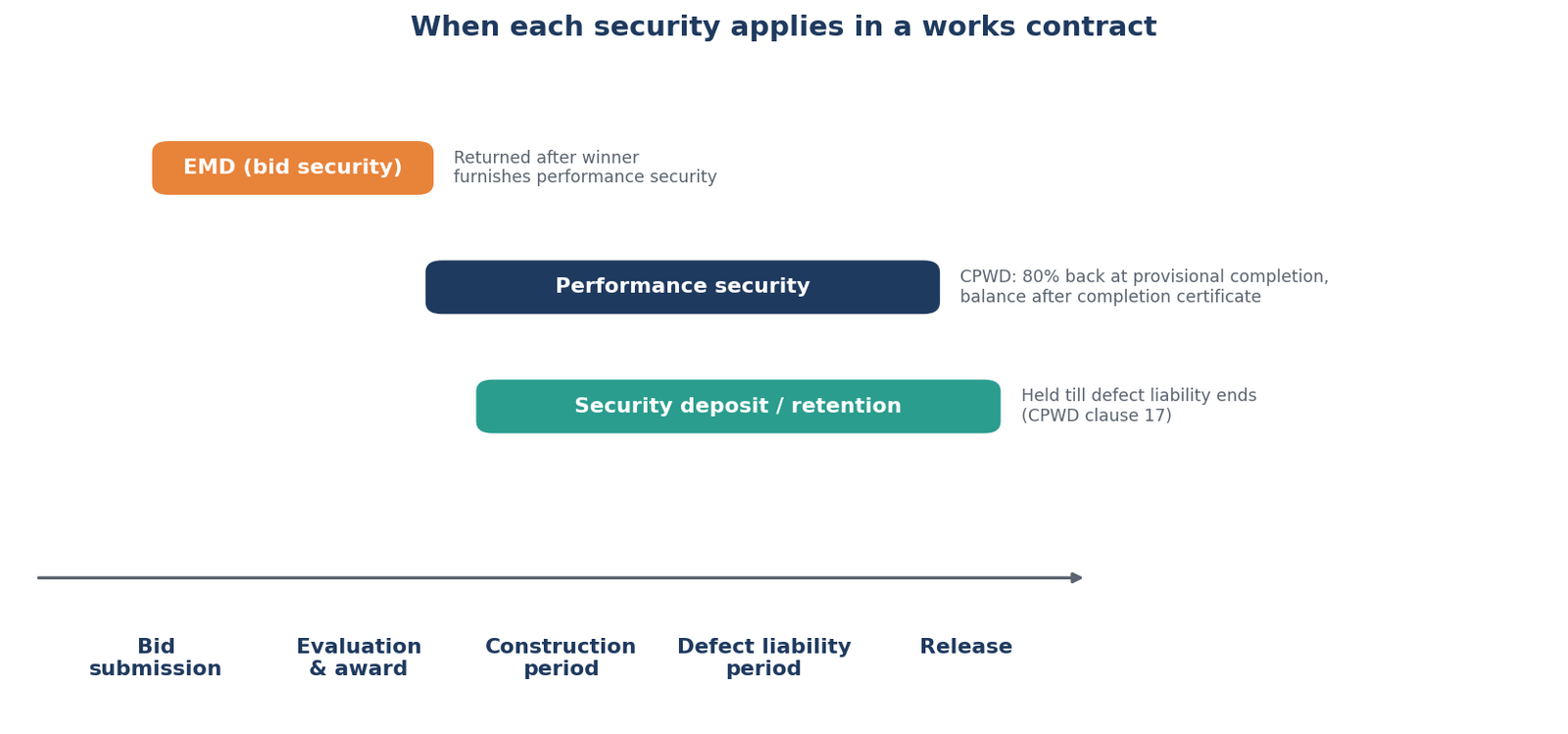
Table of contents
- 1. What is performance security?
- 2. Performance security vs EMD vs security deposit
- 3. How much performance security is required?
- 4. In what form can you give performance security?
- 5. When must it be submitted, and how long is it valid?
- 6. When can the department forfeit it?
- 7. When do you get it back?
- 8. Performance security in MoRTH / NHAI highway contracts
- 9. Performance security on GeM
- 10. A quick example
- 11. Practical tips for contractors
- Key takeaways
You have just won a government tender. Before the department signs the agreement, it asks you for one thing first: a performance security. Many new contractors confuse it with the EMD they paid with the bid, or with the retention money cut from their bills. They are three different things, and mixing them up can cost you money.
This article explains what performance security is, how much a tender can ask for, the forms in which you can give it, how long the department keeps it, when it can be forfeited, and how to get it back, including the rules in CPWD and MoRTH/NHAI contracts.
1. What is performance security?
Performance security is a financial guarantee taken from the successful bidder only, after the contract is awarded, to make sure the contractor performs the contract properly. Rule 171(i) of the General Financial Rules (GFR), 2017 puts it simply: “To ensure due performance of the contract, Performance Security is to be obtained from the successful bidder awarded the contract.”
If the contractor abandons the work, refuses to proceed, or commits a serious default, the department can forfeit or encash this security. It is the department’s safety net for the whole period of performance.
2. Performance security vs EMD vs security deposit
These three securities run at different stages of a contract. The table and the diagram below show the difference clearly.
| Point | EMD (bid security) | Performance security | Security deposit / retention |
|---|---|---|---|
| When given | With the bid | After award, before signing the agreement | Deducted from each running bill during execution |
| Who gives it | Every bidder | Only the winning bidder | Only the winning contractor |
| How much | Fixed in the bid document | Percentage fixed in the bid document (GFR: 3-10% for works) | CPWD: 2.5% of the gross amount of each running and final bill, until 2.5% of the tendered amount is held (clause 1A) |
| Purpose | Ensures only serious bidders participate | Ensures due performance of the whole contract | Covers defects that appear after completion |
| When returned | To losers after award; to the winner after he furnishes performance security | On completion, in stages (see section 7) | CPWD: not before 12 months after completion or till the final bill is passed, whichever is later (clause 17) |
3. How much performance security is required?
The exact percentage is always written in the bid document. The limits come from GFR Rule 171(i), which the Department of Expenditure has amended over time:
- Works and plant contracts: 3 to 10 per cent of the contract value (as amended from 3 April 2023).
- Goods, consultancy and non-consultancy services: 3 to 5 per cent (amendment dated 1 January 2024).
- CPWD works contracts: the percentage written in the tender’s Schedule E. The base GCC proforma shows 5 per cent of the tendered amount, but the tender’s own schedule and any amendments to it always govern, so read the bid document.
A short history, because older tender documents still quote old figures: GFR 2017 originally said 5 to 10 per cent. During the pandemic this was cut to a flat 3 per cent (office memorandum of 12 November 2020, extended up to 31 March 2023). From April 2023 the range became 3 to 10 per cent, and from January 2024 goods and services came down to 3 to 5 per cent. Works contracts stayed at 3 to 10 per cent.
State governments, PSUs and private owners fix their own figures within or alongside these limits, so always read the bid document.
4. In what form can you give performance security?
GFR Rule 171(i) and the CPWD GCC allow these forms:
- Insurance surety bonds
- Account payee demand draft
- Fixed deposit receipt (FDR) from a commercial bank
- Bank guarantee, including e-BG, from a commercial bank
- Online payment, where the bid document accepts it
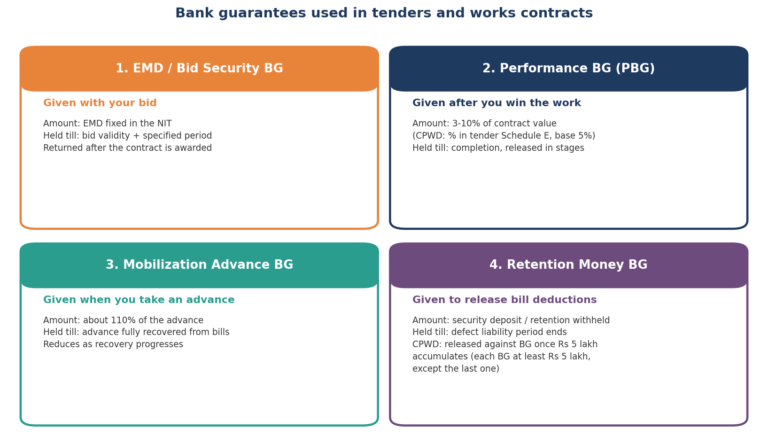
In practice, most contractors give a bank guarantee (PBG) because it does not block their cash. The bank charges a commission and usually takes some margin or collateral. How a bank guarantee works, its types and its costs are covered in detail in our companion article on bank guarantees.
5. When must it be submitted, and how long is it valid?
- Timing: after the letter of acceptance, within the time stated in the bid document (in CPWD contracts, the period given in Schedule F; the Engineer-in-Charge can extend it on written request, as Schedule F allows), and normally before the agreement is signed. If you do not submit it in time, your EMD can be forfeited and the award cancelled.
- Validity: it must cover the construction period and usually the defect liability period. Under CPWD clause 1(ii), the performance guarantee is initially valid up to the stipulated date of completion plus a minimum of six months, and it must be extended whenever the completion time is extended.
Never let the validity expire while your obligations are alive. If the work runs late and you do not extend the guarantee, the Engineer-in-Charge can claim the full amount of the performance guarantee, in effect an “extend or pay” situation.
6. When can the department forfeit it?
Typical grounds are:
- Abandoning the work or refusing to start
- Serious or persistent default leading to termination of the contract (under CPWD clause 1(iv), on determination or rescission the performance guarantee stands forfeited in full)
- Failure to pay the government any amount due under the contract within 30 days of notice
- Failure to extend the validity of the guarantee itself
Two points are often missed. First, forfeiture of performance security is in addition to liquidated damages for delay: LD compensates the department for late completion, while performance security protects the whole performance. In a terminated contract, both can bite. Second, if you gave the security as a bank guarantee, the department simply demands payment from the bank, and the bank must pay on demand. Courts almost never stop this, as explained in the bank guarantee article.
7. When do you get it back?
This depends on the contract. The CPWD GCC pattern (clauses 1(ii) and 1(v)) is a useful guide:
- On substantial completion: the Engineer-in-Charge records a provisional completion certificate, and 80 per cent of the performance guarantee is returned, without interest. On contracts that include maintenance after construction, 40 per cent is returned at this stage.
- On final completion: after the completion certificate is recorded by the competent authority, the performance guarantee is returned, without interest. Where the contract includes maintenance of the building and services after construction, 50 per cent of the guarantee is retained as security deposit and returned year by year in proportion.
Do not confuse this with the separate security deposit (retention) refund under clause 17: it is generally not refunded before 12 months after the completion certificate (six months for works costing Rs 10 lakh or less, except road work) or until the final bill is prepared and passed, whichever is later. For road work, half may be refunded after six months and the balance after twelve months.
In other contracts, read the release clause in your agreement. Practical tip: apply for release in writing at each milestone. Do not wait for the department to remember.
8. Performance security in MoRTH / NHAI highway contracts
Highway contracts of the Ministry of Road Transport and Highways (MoRTH) and NHAI follow their own model agreements. The standard EPC (engineering, procurement and construction) agreement, Article 7, says:
- Amount and form: an irrevocable and unconditional bank guarantee for 5 per cent of the Contract Price, in the format at Schedule G, within 10 days of signing the agreement. Your bid security is returned once this guarantee is in place.
- Validity: until 60 days after the Defects Liability Period. You may give it for two years at a time, but you must extend it at least two months before it expires.
- Late submission: you can get up to 30 extra days, but you pay damages of 0.01 per cent of the Contract Price per day; after that the agreement is treated as terminated and the bid security is encashed.
- Additional Performance Security: if your bid is more than 10 per cent below the estimated project cost, you must give an extra guarantee – 20 per cent of the difference if the bid is 10 to 20 per cent below estimate, 30 per cent if more than 20 per cent below. It stays valid until 28 days after the completion certificate and is returned within 28 days of it.
- Release: the performance security is returned within 60 days of the later of the maintenance period or the defects liability period ending, and only after the defects found have been rectified.
In item-rate highway tenders under the standard bidding document used for national highways and centrally sponsored road works, the particular conditions typically require an unconditional bank guarantee for 5 per cent of the accepted contract amount, in the format given in the bid document, and the guarantee must be in place before the contract agreement is signed. The contract data of your specific tender always governs.
9. Performance security on GeM
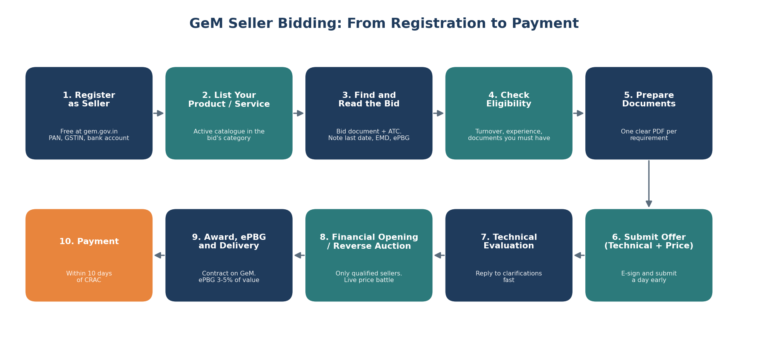
On the Government e-Marketplace (GeM), the bid-stage security is the EMD, as explained in our article on the GeM bidding process. After you win an order, some buyers ask for an electronic performance bank guarantee (ePBG). The amount and format are given in the bid or order conditions, and the ePBG request document is generated from the order details on the portal. Not every GeM order needs it, so check your bid conditions.
10. A quick example
You win a works contract for Rs 1 crore. The bid document asks for 5 per cent performance security.
- You furnish a bank guarantee for Rs 5,00,000 within the time given in Schedule F
- The bank takes an FDR margin and charges commission, say about 1 per cent a year
- Validity: stipulated completion date plus six months, extended if the time is extended
- The work finishes on time. You get Rs 4,00,000 (80 per cent) released with the provisional completion certificate, and the balance Rs 1,00,000 after the completion certificate
- If instead you had abandoned the work at 60 per cent progress, the department could encash the full Rs 5 lakh, and also recover liquidated damages and the extra cost of completing the work from your other dues
11. Practical tips for contractors
- Read the performance security percentage and accepted forms in the bid document before you price the tender. Guarantee charges are a real cost.
- Submit the security in the exact format given in the tender, on stamp paper of the required value.
- Diarise the expiry date of every guarantee. Extend it before the department claims it.
- Got a time extension? Extend the security validity in the same week.
- Track the release milestones (provisional and final completion) and apply in writing.
- On NHAI EPC projects, watch the extra deadlines: 10 days for the guarantee, 0.01 per cent per day damages for delay, and the additional guarantee if your bid was far below estimate.
Key takeaways
- Performance security is taken only from the winning bidder, after award, to guarantee due performance.
- GFR limits today: 3-10 per cent for works and plant, 3-5 per cent for goods and services. In CPWD tenders, the Schedule E percentage of that tender governs (base proforma: 5 per cent).
- MoRTH/NHAI EPC contracts take 5 per cent of the Contract Price as an unconditional BG, valid till 60 days after the defects liability period, with an additional guarantee for bids far below estimate.
- It is different from EMD (bid stage) and from retention money (cut from bills).
- Forfeiture is over and above liquidated damages.
- Claim the release yourself, in writing, at each milestone.
Rajesh Pant is a Civil Engineer and Infrastructure Management professional with approximately 25 years of experience in the planning, implementation, coordination, management and execution of large-scale government infrastructure projects. His professional experience encompasses project management, procurement, contract administration, construction management and quality control of infrastructure projects. He also possesses nearly eight years of experience in Externally Aided Projects (EAPs), particularly in project implementation, procurement and contract management of World Bank-funded projects. His professional exposure includes working with projects financed by multilateral development organisations, providing valuable insights into international procurement practices, project implementation frameworks and contract management requirements. He holds a Master of Technology (M.Tech.) in Civil Engineering and a Master of Business Administration (MBA) in Infrastructure Management, combining technical engineering expertise with management and administrative capabilities. With extensive experience in public infrastructure development and government project management, Rajesh brings a practical, multidisciplinary perspective to the fields of contract management, procurement, project management and construction management.