Mobilization Advance in Construction Contracts: Meaning, Interest and Recovery (With Worked Example)
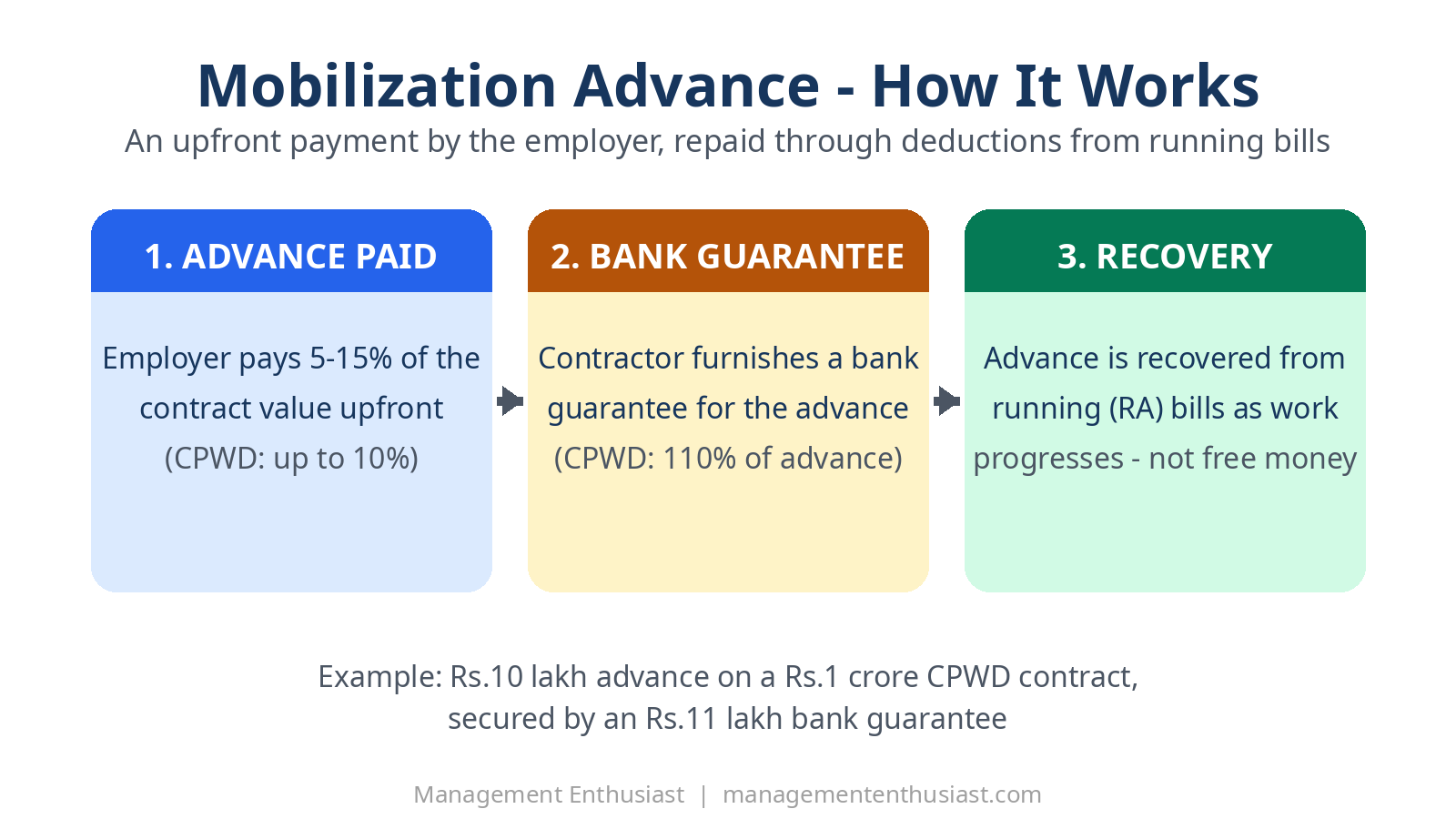
Table of contents
- Introduction
- 1. What Is a Mobilization Advance in Construction?
- 2. Why Do Employers Pay a Mobilization Advance?
- 3. Typical Percentage, Security and Interest
- 4. Mobilization Advance Under FIDIC (Clause 14.2)
- 5. Mobilization Advance Under CPWD (Clause 10B)
- 6. Worked Example: Rs.1 Crore CPWD Contract
- 7. Practical Points for Contractors
- Conclusion
Introduction
A contractor who wins a new project has to spend money long before the first payment arrives. Labour must be hired and moved to site, equipment transported and erected, site offices and stores set up, and initial materials ordered – all within the first few weeks of the work.
To ease this initial cash-flow burden, many construction contracts provide for a mobilization advance: an upfront payment by the employer that helps the contractor mobilize resources and start work promptly. It is not an extra payment – the entire advance is recovered through deductions from the contractor’s running bills.
This article explains what a mobilization advance is, the typical percentage, the bank guarantee and interest involved, the provisions under FIDIC and CPWD contracts, and a worked example with numbers.
1. What Is a Mobilization Advance in Construction?
A mobilization advance is a payment made by the employer to the contractor at the start of a project, specifically to finance mobilization – the one-time costs of setting up for the work.
It is typically used for:
Hiring and transporting labour and staff to the site.
Mobilizing construction plant and equipment.
Setting up site offices, stores, workshops and labour camps.
Purchasing initial materials and consumables.
Because the advance is recovered from later payments, it effectively works as a loan from the employer – interest-free in some contracts, interest-bearing in others. It should not be confused with a secured advance, which is paid against materials brought to site (CPWD Clause 10B covers secured advances separately).
2. Why Do Employers Pay a Mobilization Advance?
A mobilization advance benefits both parties:
Faster start: the contractor can mobilize immediately instead of arranging its own working capital first.
Better bid prices: when no advance is available, bidders load their financing costs into the rates – the employer eventually pays for it anyway.
Level playing field: smaller contractors with limited access to bank credit can compete for larger works.
The employer stays protected: the advance is covered by a bank guarantee and recovered from running bills.
3. Typical Percentage, Security and Interest
The exact terms depend on the contract, but the usual provisions are:
| Parameter | Typical provision |
|---|---|
| Advance amount | 5% to 15% of the contract value (10% is common) |
| Security | Bank guarantee for 100-110% of the advance, from an approved bank |
| Interest | Interest-free in many contracts (for example FIDIC); CPWD charges simple interest @10% per annum |
| Recovery | Proportionate deductions from running or interim bills |
| Full recovery | Before the final bill; under CPWD, by the time 80% of the tendered amount is billed |
4. Mobilization Advance Under FIDIC (Clause 14.2)
FIDIC contracts (Red Book 1999 and 2017) deal with this under Sub-Clause 14.2, Advance Payment:
An interest-free advance for mobilization is paid when stated in the Appendix to Tender (1999) or the Contract Data (2017).
The contractor first submits an advance payment guarantee, issued by an approved bank, for the full amount of the advance.
The guarantee amount is progressively reduced as the advance is repaid.
The advance is repaid through proportionate deductions in the interim Payment Certificates, as stated in the contract data.
In the United States, the same concept appears in public-works contracts as a mobilization payment or mobilization bid item, often capped at around 5-10% of the contract price and sometimes released in instalments.
5. Mobilization Advance Under CPWD (Clause 10B)
For Indian public works, the CPWD General Conditions of Contract provide a mobilization advance under Clause 10B:
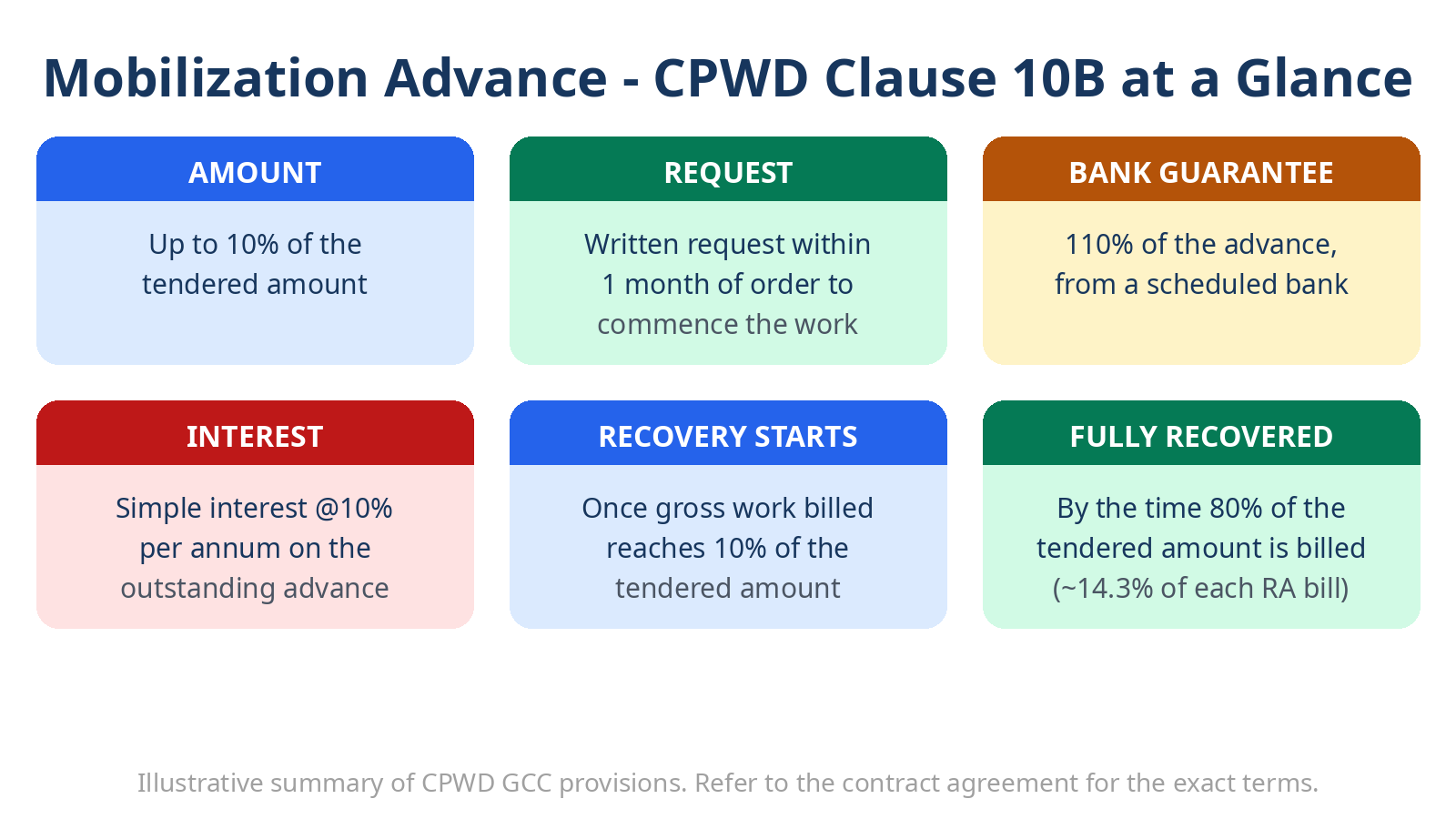
Amount: up to 10% of the tendered amount.
Request: the contractor must apply in writing within one month of the order to commence the work; the advance may be paid in instalments.
Security: a bank guarantee of 110% of the advance amount from a scheduled bank, kept valid until full recovery.
Interest: simple interest at 10% per annum on the outstanding advance until it is fully recovered.
Recovery: from running account (RA) bills, beginning once the gross work billed reaches 10% of the tendered amount and completed by the time 80% is billed – roughly 14.3% of each RA bill in that band.
6. Worked Example: Rs.1 Crore CPWD Contract
| Item | Amount / rule |
|---|---|
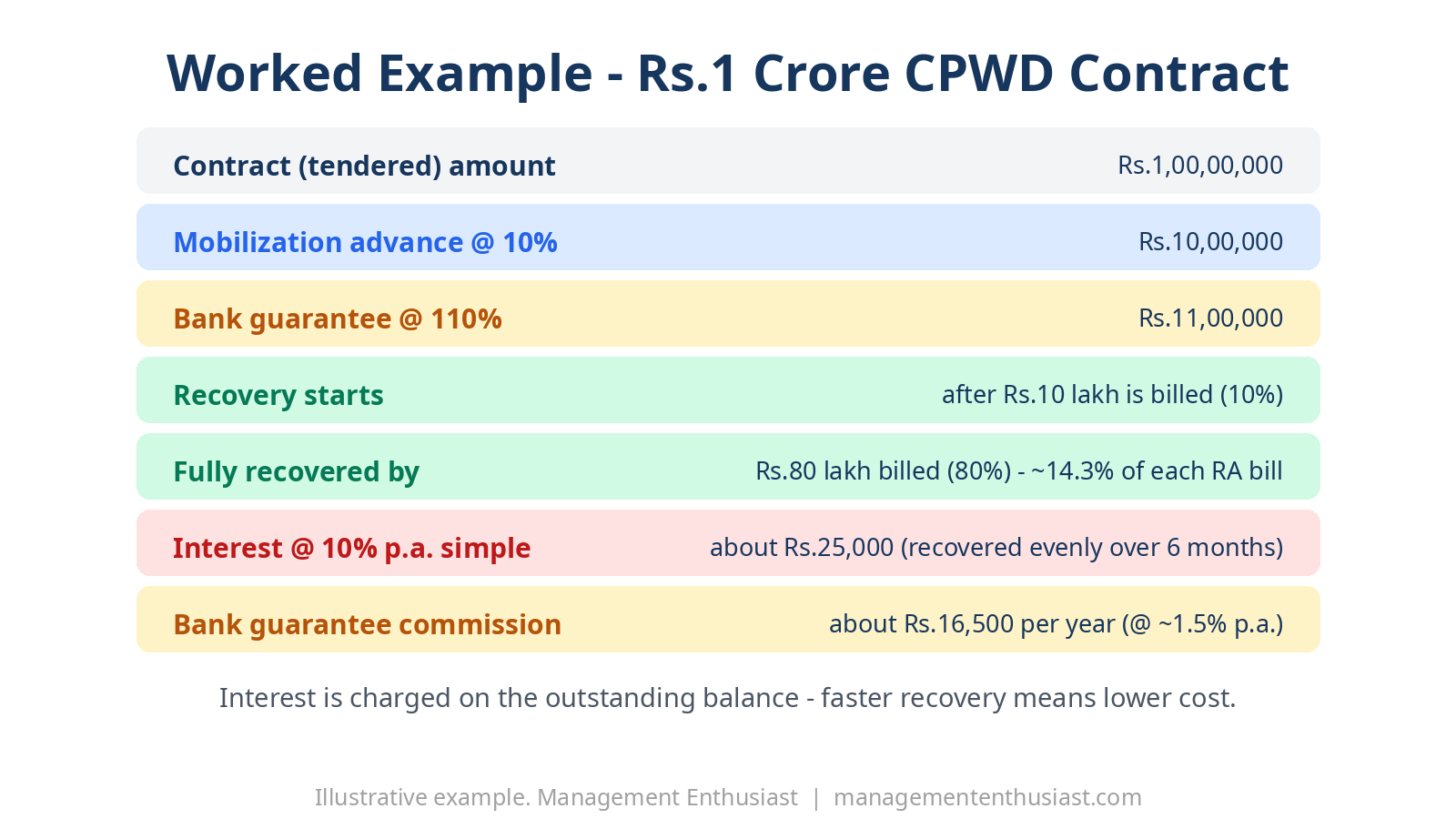
| Contract (tendered) amount | Rs.1,00,00,000 |
| Mobilization advance @ 10% | Rs.10,00,000 |
| Bank guarantee @ 110% | Rs.11,00,000 |
| Recovery starts | after Rs.10 lakh of work is billed (10%) |
| Fully recovered by | Rs.80 lakh billed (80%), at about 14.3% of each RA bill |
| Interest @ 10% p.a. simple | about Rs.25,000 if recovered evenly over 6 months |
| Bank guarantee commission | about Rs.16,500 per year (@ roughly 1.5% p.a.) |
7. Practical Points for Contractors
A mobilization advance is not free money. Price the interest and bank guarantee commission into your bid.
Keep the bank guarantee alive until the advance is fully recovered; renewals add cost.
Check the recovery deduction in every RA bill – an error early on compounds across the project.
Use the advance only for mobilization. Diversion can lead to immediate recovery or action under the contract.
Read the recovery clause carefully: when recovery starts, how much is deducted per bill, and by when it must be fully recovered.
Conclusion
A mobilization advance is a useful contract tool: it funds the contractor’s initial mobilization and helps the project start on time, while the employer stays protected through a bank guarantee and staged recovery from running bills. Knowing the percentage, security, interest and recovery mechanism – whether under FIDIC Clause 14.2 or CPWD Clause 10B – helps contractors price their bids correctly and avoid disputes later.
Related reading: Extension of Time in Construction Contracts | What Is an RFI in Construction? How to Write One
Rajesh Pant is a Civil Engineer and Infrastructure Management professional with approximately 25 years of experience in the planning, implementation, coordination, management and execution of large-scale government infrastructure projects. His professional experience encompasses project management, procurement, contract administration, construction management and quality control of infrastructure projects. He also possesses nearly eight years of experience in Externally Aided Projects (EAPs), particularly in project implementation, procurement and contract management of World Bank-funded projects. His professional exposure includes working with projects financed by multilateral development organisations, providing valuable insights into international procurement practices, project implementation frameworks and contract management requirements. He holds a Master of Technology (M.Tech.) in Civil Engineering and a Master of Business Administration (MBA) in Infrastructure Management, combining technical engineering expertise with management and administrative capabilities. With extensive experience in public infrastructure development and government project management, Rajesh brings a practical, multidisciplinary perspective to the fields of contract management, procurement, project management and construction management.