CBR Test (California Bearing Ratio) Explained: Procedure, Formula and Design Use
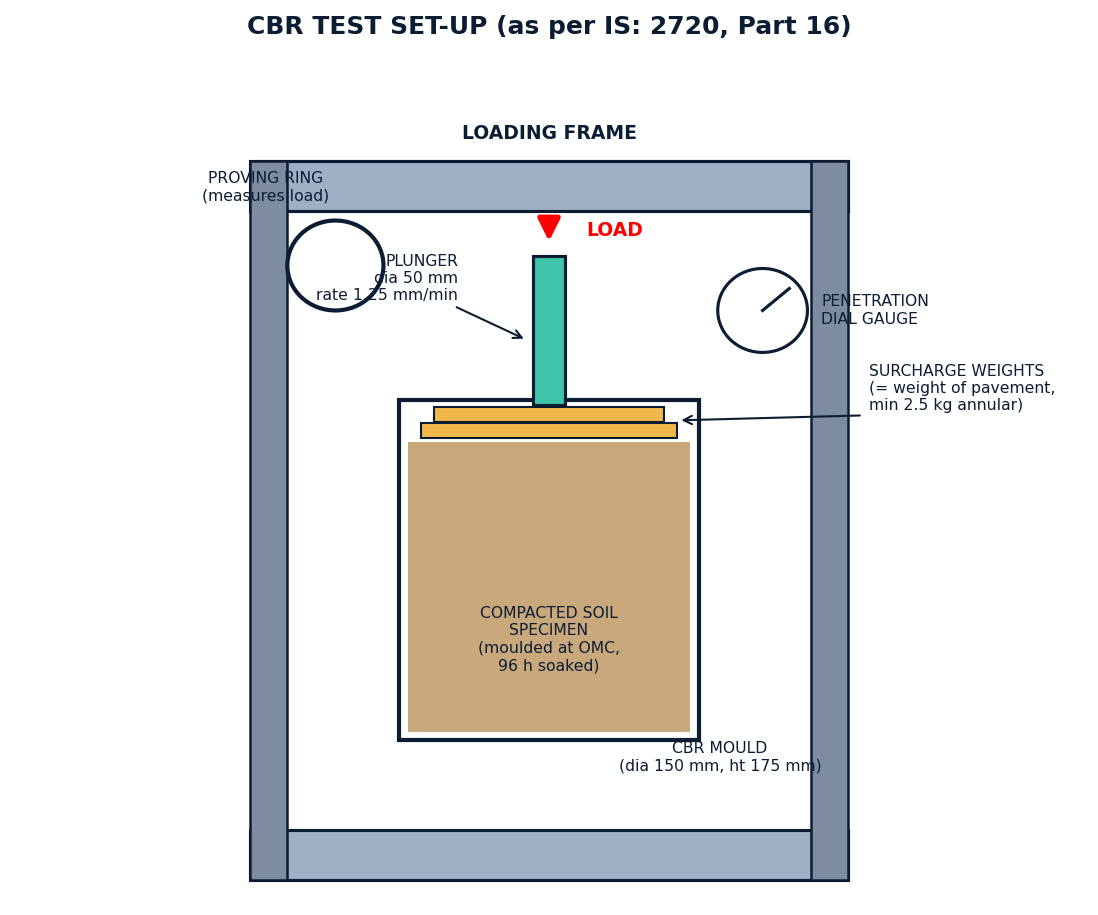
Table of contents
- 1. What Is CBR, and Why Does a Pavement Designer Care?
- 2. The Laboratory Test as per IS: 2720 (Part 16)
- 3. The Formula, and Which Value to Take
- 4. Typical CBR Values, and What Each Range Means for Design
- 5. Worked Example: From the Mould to the Pavement Section
- 6. Field Alternatives and Correlations
- 7. Common Site Mistakes and Quality-Control Tips
- 8. Exam Corner: What to Remember
- 9. Key Takeaways
IRC Codes Explained, Part 2: written for road contractors, site engineers and quality control staff, and equally useful for GATE (CE), SSC JE, ESE and state AE/JE aspirants.
1. What Is CBR, and Why Does a Pavement Designer Care?
The California Bearing Ratio (CBR) is a simple strength test for the soil on which a road pavement will rest. A standard plunger is pushed into the compacted soil, and the load needed is compared with the load needed to push the same plunger into standard crushed stone. The ratio, in per cent, is the CBR. Crushed stone is 100 per cent by definition; ordinary subgrade soils come out far below that.
This one number decides how much pavement your road needs. In Part 1 of this series (Flexible Pavement Design as per IRC:37-2018), we saw that a flexible pavement design needs only two real inputs: design traffic in MSA, and subgrade strength. That subgrade strength is the CBR. Open any design catalogue plate of IRC:37-2018 and the very first thing printed on it is the effective CBR it applies to. A weak CBR means thicker GSB, WMM and bituminous layers; a strong CBR means a thinner, cheaper crust. On a long road, one or two points of CBR can change the estimate by lakhs per kilometre.
The test is standardized in IS: 2720 (Part 16), Laboratory Determination of CBR. It is also the most commonly fudged soil test on site, so knowing it properly pays twice: once in design, and once in quality control.
2. The Laboratory Test as per IS: 2720 (Part 16)
The test has two stages: preparing and soaking the specimen, and then penetrating it. The figure below shows the set-up.
Step 1 – Specimen preparation. Take the soil passing the 20 mm sieve (oversize is replaced by an equal weight of material between 20 mm and 4.75 mm). Compact a remoulded specimen in the CBR mould (150 mm diameter) at the optimum moisture content, to the density the road specification demands. For subgrade design, IRC:37 wants at least 97 per cent of the maximum dry density from the Proctor compaction test (IS: 2720, Part 7 or 8).
Step 2 – Soaking for 96 hours. Place a filter paper, the perforated plate and surcharge weights on the specimen. The surcharge represents the weight of the pavement that will sit on this soil, taken to the nearest 2.5 kg. Immerse the whole mould in water for 96 hours (4 days), with the swelling dial mounted on top. Soaking simulates the worst wet condition the subgrade will see during monsoon. The daily dial readings give the expansion ratio, which flags expansive soils. IRC:37 designs on the 4-day soaked CBR.
Step 3 – Penetration. Drain the specimen for 15 minutes, seat it in the loading frame with the same surcharge weights, and push a 50 mm diameter plunger into the soil at 1.25 mm per minute. Record the load at penetrations of 0.5, 1.0, 1.5, 2.0, 2.5, 4.0, 5.0, 7.5, 10.0 and 12.5 mm. Plot the load-penetration curve. If the curve bends the wrong way at the start (surface irregularity), correct it with the tangent method given in the code before reading the loads.
3. The Formula, and Which Value to Take
CBR (%) = (Test load at the chosen penetration / Standard load at the same penetration) x 100
The standard loads come from tests on crushed stone, the material defined as CBR = 100 per cent:
| Penetration (mm) | Standard unit load (kg/cm2) | Standard total load (kg) |
|---|---|---|
| 2.5 | 70 | 1370 |
| 5.0 | 105 | 2055 |
Calculate CBR at both 2.5 mm and 5.0 mm. Normally the 2.5 mm value is higher, and that is reported as the CBR. If the 5.0 mm value comes out higher, the code says to repeat the test; if the repeat test gives the same pattern, the 5.0 mm value is taken. Report the average of at least three specimens for each soil type.
Worked calculation. Suppose the corrected test loads read 96 kg at 2.5 mm and 135 kg at 5.0 mm:
- CBR at 2.5 mm = 96 / 1370 x 100 = 7.0 per cent
- CBR at 5.0 mm = 135 / 2055 x 100 = 6.6 per cent
The 2.5 mm value is higher, so the CBR of this soil is reported as 7.0 per cent.
4. Typical CBR Values, and What Each Range Means for Design
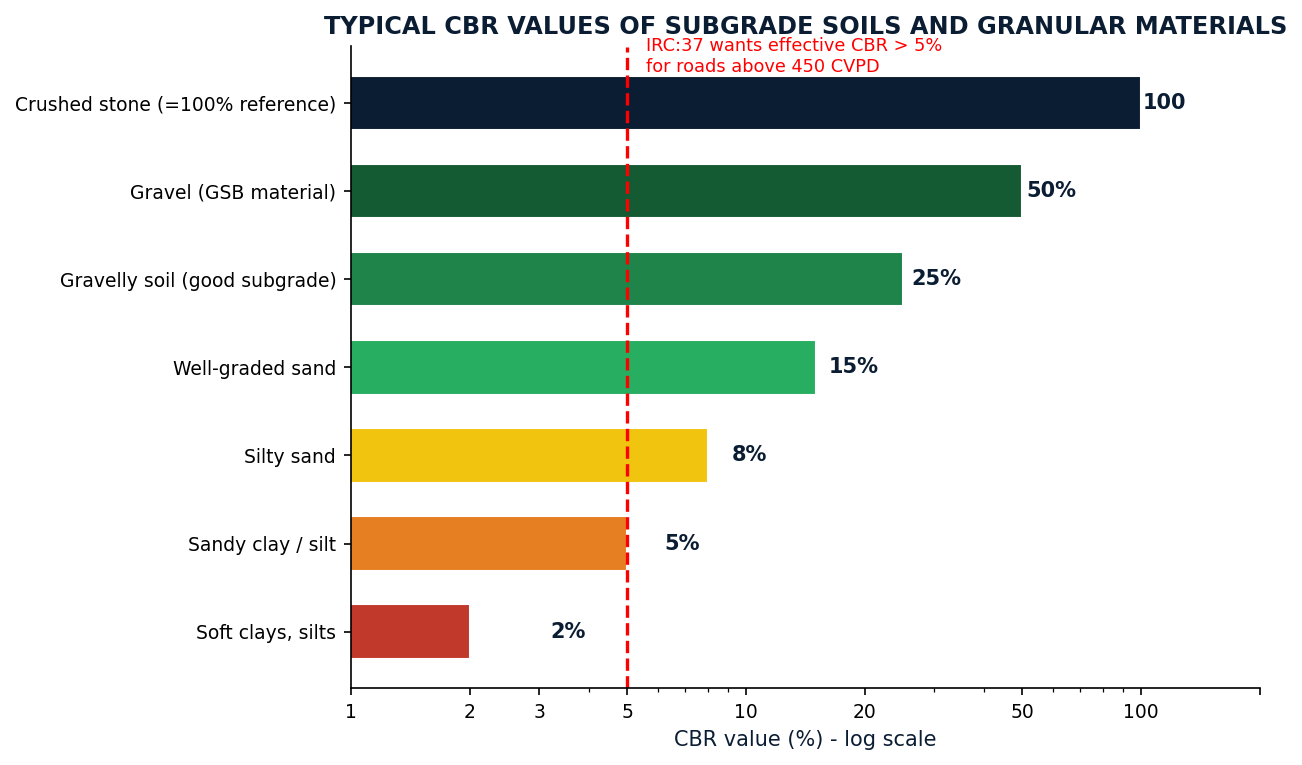
| CBR range (%) | Subgrade rating | Typical material | Design implication |
|---|---|---|---|
| Below 3 | Very poor | Soft clays, silts | Subgrade must be improved or replaced before designing the pavement |
| 3 to 5 | Poor | Clayey and silty soils | Below the IRC:37 floor for busier roads; stabilization usually needed |
| 5 to 10 | Fair to good | Silty sand, sandy clay | Acceptable subgrade; thicker granular layers |
| 10 to 20 | Good | Well-graded sand, gravelly soil | Strong subgrade; thinner crust |
| Above 20 | Excellent | Gravel, GSB-type material | More a base/sub-base material than a subgrade |
Remember the floor from Part 1: for a road expected to carry more than 450 commercial vehicles per day (two-way) at opening, IRC:37-2018 wants the effective subgrade CBR to be more than 5 per cent. Weaker soil has to be improved first, by replacement or stabilization.
5. Worked Example: From the Mould to the Pavement Section
Here is how the CBR you measure in the lab turns into a pavement section. IRC:37-2018 is the Indian Roads Congress code for designing flexible (bituminous) pavements. It needs two main inputs: the design traffic, counted in msa (million standard axles, the total heavy-vehicle loading the road must carry over its life), and the strength of the subgrade soil, which is the CBR. Take a two-lane State Highway with a design traffic of 20 msa. The borrow soil for the subgrade is tested as in Sections 2 and 3, and the 4-day soaked CBR on three specimens comes out as 6.5, 7.0 and 7.5 per cent. The average, 7.0 per cent, is adopted as the effective CBR.
Now feed that 7 per cent into the IRC:37-2018 design catalogue (the code’s ready-made thickness charts, one plate for each CBR value). You do not need to have read our IRC:37 article to follow this; if you want the full method, it is optional further reading in Part 1 of this series, Flexible Pavement Design as per IRC:37-2018.
You can also watch the Part 1 video here:
- Check the floor. The road carries more than 450 commercial vehicles per day (CVPD), and 7 per cent clears the 5 per cent floor. Design can proceed.
- Read the catalogue. Plate 3 of IRC:37-2018 (effective CBR 7%), 20 msa column: BC (bituminous concrete) 30 mm, DBM (dense bituminous macadam) 100 mm, WMM (wet mix macadam) 250 mm, GSB (granular sub-base) 200 mm, total 580 mm above the subgrade.
- Verify by analysis. Above 2 msa, the code wants the section verified with IITPAVE, the software used for pavement analysis, using project mix properties before it enters a DPR or estimate.
Had the same soil tested at CBR 4 per cent, the road would first need subgrade improvement, and then a different catalogue plate with a thicker crust. That is the whole economics of this test in one line: the CBR you report sets the pavement you pay for.
6. Field Alternatives and Correlations
- DCP. The Dynamic Cone Penetrometer (DCP) is the common field tool: a 60-degree cone on a rod, driven by an 8 kg hammer falling 575 mm. The penetration per blow correlates with CBR, and the profile can be read to about 800 mm depth. Useful for existing roads, borrow-area screening and checking compaction uniformity along the alignment. Treat the correlation as indicative; confirm critical stretches with lab CBR.
- Plate load test. The plate load test (IS: 9214) gives the modulus of subgrade reaction k, the input rigid pavement design (IRC:58) uses. Do not mix the two: CBR for flexible, k for rigid.
- When lab CBR goes wrong. A single stone right under the plunger inflates the reading; a specimen compacted loose or tested unsoaked when the design wants soaked does the opposite. Wrong surcharge, skipped soaking, and readings taken without correcting the load-penetration curve are the classic lab errors. When a result looks off, examine the broken specimen for oversize particles before accepting it.
7. Common Site Mistakes and Quality-Control Tips
- Under-compaction. Compaction below the specified density is the commonest reason for a low CBR. On site, check field density at the frequency the specification lays down, not just when the engineer visits.
- Skipping the soak. Design CBR is the soaked value. An unsoaked result on a dry-season project can look twice as good and will not survive the first monsoon. Insist on the 96-hour soaking in the lab report.
- Too few samples. Soil changes along the alignment. IRC:37 wants the CBR of each soil type averaged from at least three specimens, and the design value taken as the 90th percentile on major roads (80th percentile below 20 msa on other roads). One sample per kilometre is a minimum discipline, not a luxury.
- Watch the top 500 mm. On fill, the top 500 mm below the pavement decides the design. If the borrow soil for this layer differs from the embankment below, use the code’s effective-CBR procedure instead of testing only the top layer.
- Do not ignore swelling. Report the expansion ratio with the CBR. A high swell value warns you of expansive soil even when the CBR number looks acceptable.
8. Exam Corner: What to Remember
- CBR = (test load / standard load) x 100, at 2.5 mm and 5.0 mm penetration.
- Standard total loads: 1370 kg at 2.5 mm and 2055 kg at 5.0 mm (70 and 105 kg/cm2). These two numbers appear again and again in SSC JE and GATE.
- Plunger diameter 50 mm; penetration rate 1.25 mm/min; soaking 96 hours (4 days); surcharge equal to the pavement weight, minimum 2.5 kg annular weight.
- Take the 2.5 mm value normally. If the 5.0 mm value is higher, repeat the test; on confirmation, take the 5.0 mm value.
- Readings are recorded at 0.5, 1.0, 1.5, 2.0, 2.5, 4.0, 5.0, 7.5, 10.0 and 12.5 mm.
- IRC:37 uses the 4-day soaked CBR at 97 per cent Proctor density, and wants effective CBR above 5 per cent where traffic exceeds 450 CVPD.
- CBR to resilient modulus (IRC:37): MR = 10 x CBR (MPa) up to CBR 5 per cent; MR = 17.6 x (CBR)^0.64 above that, capped at 100 MPa.
9. Key Takeaways
- CBR is the percentage strength of your subgrade soil against standard crushed stone (100 per cent), tested as per IS: 2720 (Part 16).
- The design value is the 4-day soaked CBR at the specified compaction, averaged over at least three specimens per soil type.
- This single number, with design traffic, picks the whole pavement section from the IRC:37 catalogue, as the worked example showed.
- Soaking, surcharge and compaction are where the test is won or lost; a careless CBR report designs a careless pavement.
- Next in this series: rigid pavement design as per IRC:58, where the subgrade input changes from CBR to the modulus of subgrade reaction k.
Rajesh Pant is a Civil Engineer and Infrastructure Management professional with approximately 25 years of experience in the planning, implementation, coordination, management and execution of large-scale government infrastructure projects. His professional experience encompasses project management, procurement, contract administration, construction management and quality control of infrastructure projects. He also possesses nearly eight years of experience in Externally Aided Projects (EAPs), particularly in project implementation, procurement and contract management of World Bank-funded projects. His professional exposure includes working with projects financed by multilateral development organisations, providing valuable insights into international procurement practices, project implementation frameworks and contract management requirements. He holds a Master of Technology (M.Tech.) in Civil Engineering and a Master of Business Administration (MBA) in Infrastructure Management, combining technical engineering expertise with management and administrative capabilities. With extensive experience in public infrastructure development and government project management, Rajesh brings a practical, multidisciplinary perspective to the fields of contract management, procurement, project management and construction management.